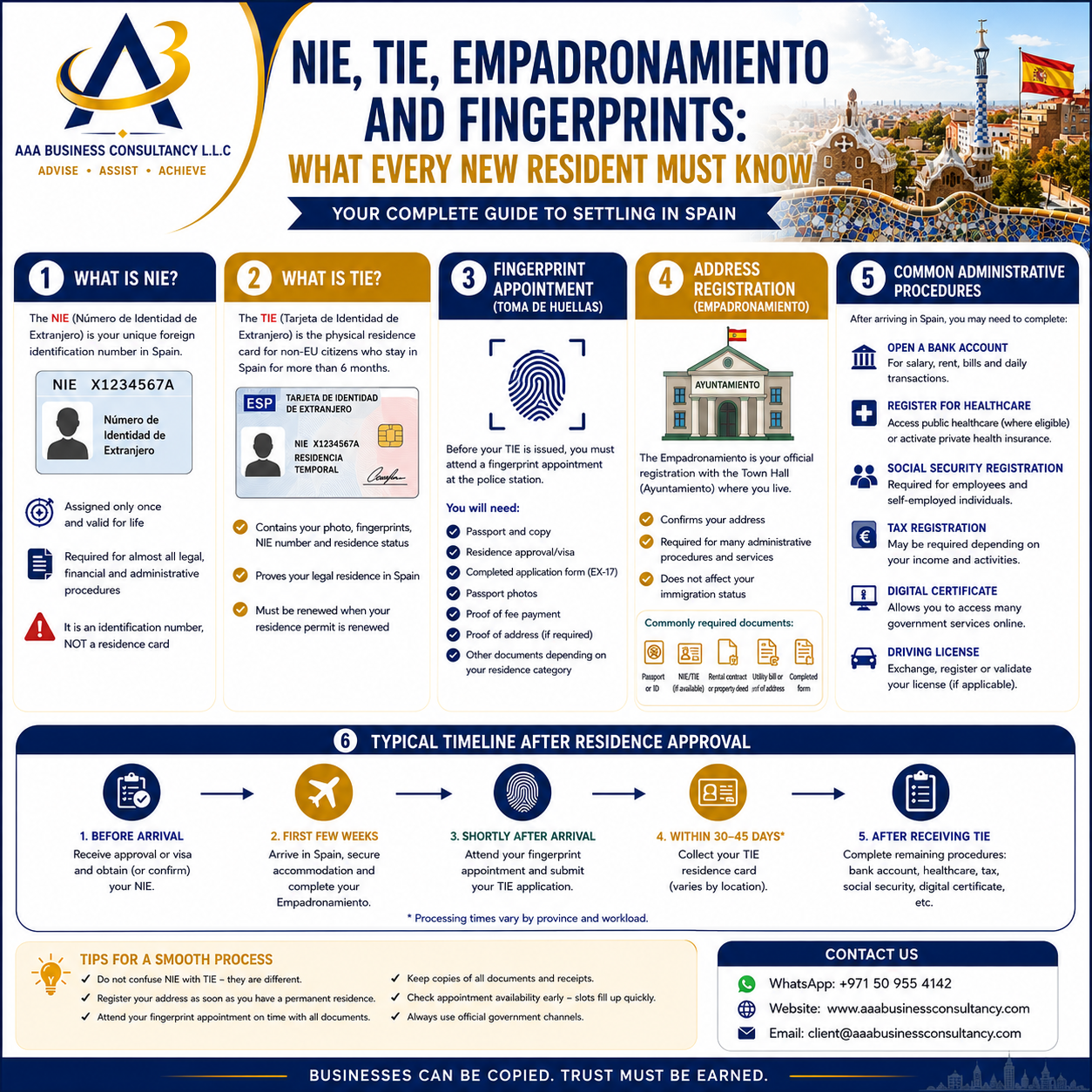
Moving to Spain is an exciting step, but receiving your visa or residence approval is not always the end of the process. After arriving in Spain, new residents may need to complete several important administrative procedures, including obtaining or confirming their NIE, applying for the TIE, attending a fingerprint appointment, and registering their address through the Empadronamiento.
Understanding these procedures can help you avoid delays and settle into your new life in Spain more smoothly.
This guide explains the main differences between the NIE Spain, TIE Spain, fingerprint appointment, and Empadronamiento, as well as the typical steps residents may need to complete after receiving approval.
What Is the NIE in Spain?
The NIE, or Número de Identidad de Extranjero, is a unique identification number assigned to foreign nationals who have financial, professional, social, or administrative interests in Spain.
The NIE is an identification number—not a physical residence card. Once assigned, it generally remains the same and is used throughout your dealings with Spanish authorities.
Your NIE may be required for many procedures, including:
- Opening a Spanish bank account
- Signing an employment contract
- Paying taxes
- Purchasing or renting property
- Registering a business
- Buying a vehicle
- Arranging utilities
- Completing Social Security procedures
- Submitting immigration applications
- Accessing certain government services
Some applicants receive their NIE during the visa or residence application process. In other cases, it may be assigned after a separate application.
It is important to remember that having an NIE does not, by itself, prove that you have legal residency in Spain.
What Is the TIE in Spain?
The TIE, or Tarjeta de Identidad de Extranjero, is the physical identity card issued to eligible non-EU foreign nationals who have been granted authorization to remain in Spain.
The TIE normally includes:
- Your full name
- Photograph
- Fingerprints
- NIE number
- Type of residence or stay authorization
- Validity period
- Other information relating to your immigration status
Unlike the NIE, which is only an identification number, the TIE is a physical biometric card connected to your residence authorization.
The Spanish Ministry of the Interior explains that the TIE documents the administrative status of foreign nationals in Spain. Its validity is linked to the authorization or recognized right under which the card was issued.
When your residence authorization is renewed or modified, you may also need to renew or replace your TIE.
NIE and TIE: What Is the Difference?
The difference can be explained simply:
NIE: Your permanent foreigner identification number.
TIE: The physical biometric card showing your immigration status and containing your NIE.
A person may have an NIE without having a TIE. However, eligible non-EU residents staying in Spain under a qualifying authorization will generally need to apply for the TIE.
What Is the Fingerprint Appointment?
The fingerprint appointment is commonly known in Spain as the Toma de Huellas appointment.
This is the in-person procedure during which the police collect your fingerprints and verify the documents needed to produce your TIE card.
Depending on your residence category and local requirements, you may need to present:
- A valid passport
- A copy of your passport
- Visa or residence approval
- Completed official application form
- Recent passport-sized photographs
- Proof of payment of the applicable administrative fee
- Proof of address or Empadronamiento, where requested
- Entry stamp or other evidence of arrival, where applicable
- Additional documents relating to your residence category
Requirements may vary depending on the type of authorization, province, and police station. Applicants should therefore check the official appointment instructions carefully before attending.
The appointment is normally completed personally because fingerprints and identity verification cannot usually be handled entirely by a representative.
When Should You Request the TIE?
The deadline depends on the residence or stay category under which the authorization was granted.
For several common non-EU residence categories, official immigration guidance states that the applicant must personally request the TIE within one month of entering Spain or within one month of receiving the relevant approval or notification. For example, the official guidance for Spain’s Non-Lucrative Residence Authorization states that the foreign national must personally request the TIE within one month of entering Spain.
The applicable deadline may be different for certain categories, including EU citizens and their non-EU family members. Applicants should follow the instructions provided in their visa, approval resolution, or official immigration guidance.
Because appointment availability can vary considerably between provinces, it is advisable to check for available appointments soon after arrival or approval.
What Is Empadronamiento?
The Empadronamiento is the process of registering your usual address in the municipal population register, known as the Padrón Municipal.
Registration is completed through the local Town Hall, or Ayuntamiento, in the municipality where you normally live.
Spanish municipal rules establish that people living in Spain should register in the municipality where they habitually reside. A person who lives in more than one municipality should register in the municipality where they spend the greatest amount of time during the year.
The Empadronamiento records your local address and may be required for different administrative procedures.
It is separate from your immigration status. Registration in the municipal register does not, by itself, prove that a foreign national is legally resident in Spain or grant immigration rights.
Documents Commonly Required for Empadronamiento
Each Town Hall may have its own requirements, but applicants are commonly asked to provide:
- A valid passport or identity document
- NIE or TIE, when available
- Completed municipal registration form
- Rental agreement
- Property ownership documents
- Authorization from the property owner or main tenant, where applicable
- Recent utility bill or other address evidence, where requested
Foreign residents may sometimes register using their passport when they have not yet received a TIE. Official municipal guidance recognizes the foreign identity card and, when it is unavailable, the passport or an eligible national identity card as identification for foreign residents.
The exact documents should always be confirmed with the relevant Town Hall.
Why Is Address Registration Important?
The Empadronamiento may be requested for procedures such as:
- Applying for or collecting certain residence documents
- Registering for healthcare, where eligible
- Enrolling children in school
- Demonstrating your usual address
- Accessing municipal services
- Completing family-related procedures
- Applying for certain benefits or local services
- Supporting future immigration or nationality applications
- Updating your official address
When you permanently move to a different municipality or address, you should update your registration so that the municipal records reflect where you actually live.
Common Administrative Procedures After Moving to Spain
In addition to the NIE, TIE, fingerprints, and Empadronamiento, new residents may need to complete other administrative procedures depending on their circumstances.
Opening a Spanish Bank Account
A Spanish bank account may be useful for receiving salary payments, paying rent, arranging direct debits, paying government fees, and managing daily expenses.
Banks may request your passport, NIE, proof of address, employment information, tax details, and evidence explaining the source of funds.
Social Security Registration
Employees, self-employed professionals, and certain other residents may need a Spanish Social Security number.
The requirements depend on your work status and residence authorization. Employees are often registered through their employer, while self-employed residents may need to complete their own registration.
Healthcare Registration
Access to Spain’s public healthcare system depends on the resident’s immigration category, Social Security status, employment, insurance arrangements, and other eligibility conditions.
Some visa holders are required to maintain private health insurance, while others may become eligible for public healthcare after completing the necessary registrations.
Tax Registration
Residents who work, operate a business, provide professional services, or become tax-resident in Spain may need to complete procedures with the Spanish Tax Agency.
Tax obligations depend on individual circumstances, including the number of days spent in Spain, employment status, source of income, and applicable international tax agreements.
Professional tax advice is recommended where a person has income, assets, or business activities in more than one country.
Digital Identification
Residents may benefit from registering for electronic identification services such as Cl@ve or obtaining a digital certificate.
These systems can make it easier to access government platforms, submit applications, check notifications, obtain official certificates, and manage administrative procedures online.
Foreign nationals registering for Cl@ve may be asked to provide their NIE together with a qualifying residence document, such as a TIE, residence permit, or EU registration certificate.
Driving Licence Procedures
Some residents may need to register, exchange, or validate their foreign driving licence, depending on their nationality, licence type, and any agreement between Spain and the issuing country.
The deadlines and requirements differ, so drivers should review the applicable rules shortly after becoming resident.
Typical Timeline After Residence Approval
The exact order may vary depending on your visa category, place of application, province, and personal circumstances. However, a typical post-approval timeline may look like this:
Before Travelling to Spain
- Check the validity dates on your visa.
- Review the conditions stated in your approval.
- Confirm whether an NIE has already been assigned.
- Prepare the documents needed for your arrival.
- Check the deadline for entering Spain.
- Research TIE and fingerprint appointment availability.
After Arriving in Spain
- Secure suitable accommodation.
- Keep evidence of your entry into Spain.
- Register your address through the Empadronamiento where appropriate.
- Request the fingerprint appointment.
- Pay the relevant administrative fee.
- Prepare the TIE application documents.
Within the Applicable TIE Deadline
- Attend the appointment personally.
- Submit the required documents.
- Provide fingerprints.
- Keep the receipt or collection document issued by the police.
For several residence categories, the TIE must be requested within one month of entry into Spain or within one month of the relevant approval. The exact starting point depends on the authorization.
After the Fingerprint Appointment
- Follow the police station’s collection instructions.
- Return to collect the card when it is ready.
- Check that the details printed on the card are correct.
- Store copies of the application receipt and card securely.
- Complete any remaining healthcare, banking, tax, employment, or Social Security procedures.
The production and collection period is not identical throughout Spain. Applicants should rely on the instructions provided by the police station rather than assuming a fixed national collection time.
Common Mistakes to Avoid
New residents can reduce the risk of delays by avoiding several common mistakes:
- Confusing the NIE number with the TIE card
- Believing that an NIE alone gives residence rights
- Waiting too long to request a fingerprint appointment
- Attending without proof of fee payment
- Bringing photographs that do not meet the required format
- Failing to carry the original passport
- Using an incorrect or incomplete application form
- Assuming the requirements are identical in every province
- Failing to update the Empadronamiento after changing address
- Booking appointments through unauthorized sellers
Official immigration appointments should be requested through the appropriate government appointment system. Applicants should be cautious of individuals or organizations offering appointments through unofficial or potentially fraudulent methods.
Planning Your Administrative Process
The procedures required after approval depend on the residence route.
A Digital Nomad Visa holder, Non-Lucrative Visa holder, student, employee, self-employed professional, and family member may each have different deadlines and document requirements.
Before completing any procedure, confirm:
- Your immigration category
- The validity of your approval
- Your deadline for entering Spain
- Whether you already have an NIE
- Whether you are required to obtain a TIE
- The correct application form
- The correct government fee
- The police station responsible for your address
- Whether Empadronamiento is required for the appointment
- The collection procedure for your card
How AAA Business Consultancy LLC Can Help
Receiving your Spain visa or residency approval is an important achievement, but settling in Spain may involve several additional administrative steps.
AAA Business Consultancy LLC provides professional guidance and personalized support for Spain visa, residency, and relocation procedures.
Our team can assist you in understanding the post-approval process, preparing the required documents, planning administrative appointments, and identifying the procedures that may apply to your individual situation.
Whether you are relocating through a Digital Nomad Visa, Non-Lucrative Visa, Student Visa, employment authorization, family residence route, or another Spanish residency category, we are committed to helping you complete your journey with confidence.
Contact AAA Business Consultancy LLC
WhatsApp: +971 50 955 4142
Website: www.aaabusinessconsultancy.com
Email: client@aaabusinessconsultancy.com
Businesses Can Be Copied. Trust Must Be Earned.