Primary Keyword: Family Reunification Spain
Secondary Keywords: Spain Family Reunification Visa, Family Residence Permit Spain, Bring Family to Spain, Spain Family Visa
Meta Title: Family Reunification Spain: Requirements and Application Process
Meta Description: Learn how Family Reunification in Spain works, including eligible family members, requirements, benefits, application steps, residence rights, and frequently asked questions.
Bring Your Family Together and Build a Future in Spain
Living in another country can open the door to new opportunities, but being separated from your family can make the experience challenging.
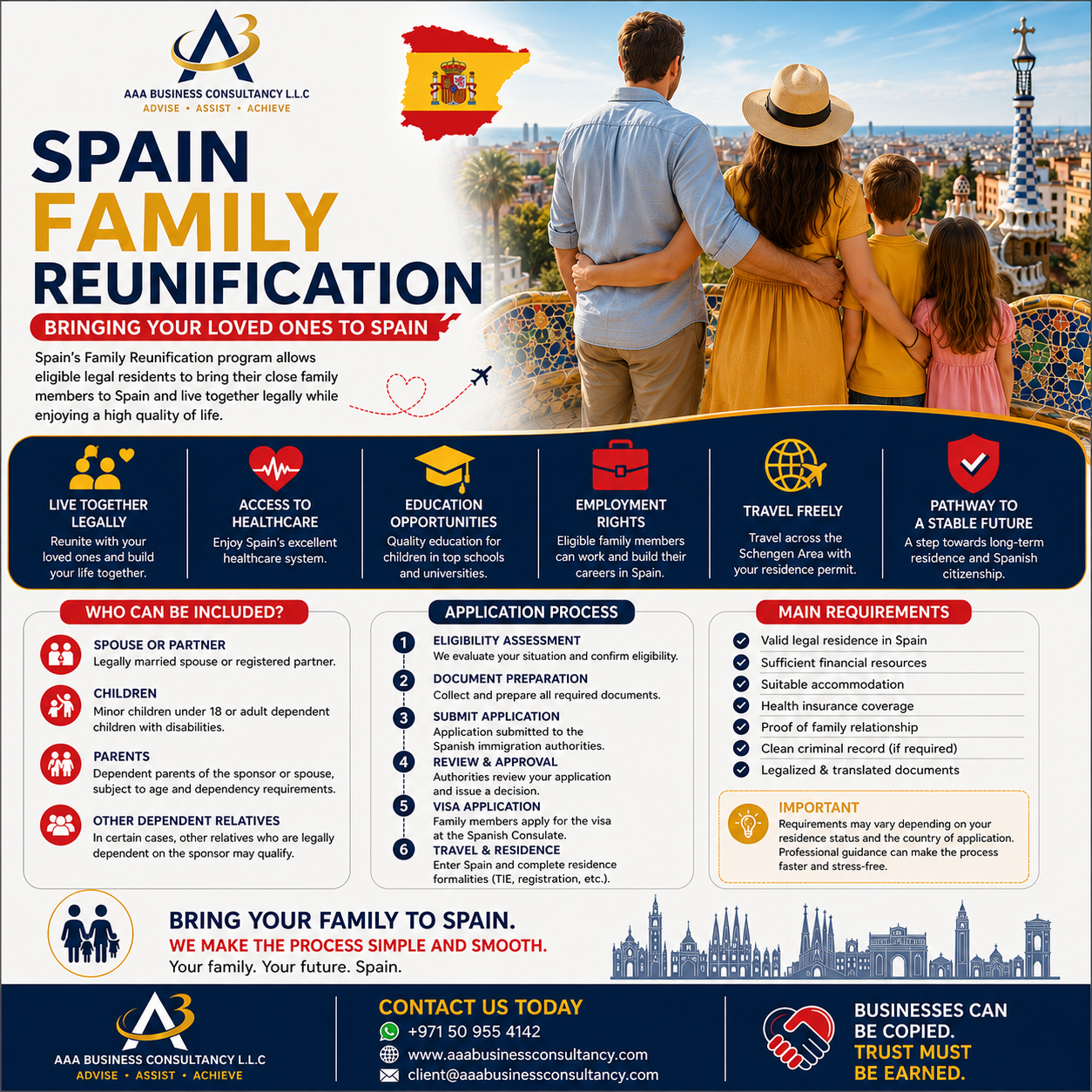
Spain’s family reunification procedure allows eligible foreign residents to bring certain close family members to Spain so they can live together legally under an established residence framework.
Through Family Reunification in Spain, eligible spouses, partners, children and, in certain circumstances, dependent parents may obtain authorization to reside with their sponsoring family member.
The Spanish immigration authorities recognize the right of legally resident foreign nationals to reunite with qualifying family members, subject to the applicable legal and financial requirements.
This guide explains who may qualify, the main requirements, the application process, residence rights and the most frequently asked questions about bringing family members to Spain.
What Is Family Reunification in Spain?
Family Reunification is an immigration procedure through which a legally resident foreign national in Spain may request residence authorization for eligible family members.
The person living legally in Spain is known as the sponsor or reunifying resident, while the family member applying to join them is known as the reunified family member.
In the standard procedure, the sponsor normally begins the residence authorization process in Spain. Once authorization is granted, a family member living abroad may be required to apply for a national family reunification visa through the appropriate Spanish Consulate.
It is important to identify the correct immigration route before applying. Family members of Spanish, European Union, European Economic Area or Swiss citizens may be covered by a different residence procedure from the general Family Reunification regime described in this article.
Who Can Be Included in Family Reunification?
Eligibility depends on the sponsor’s residence status, the relationship between the parties and the circumstances of the family member.
The following relatives may generally be considered under Spain’s Family Reunification rules.
1. Spouse
A sponsor may generally apply to reunite with their legally married spouse, provided that:
- The marriage is legally valid.
- The relationship is genuine.
- The spouses are not legally or practically separated.
- The marriage was not entered into primarily to obtain immigration benefits.
A person cannot normally sponsor more than one spouse at the same time.
2. Registered or Stable Partner
An officially registered partner may qualify when the partnership is legally recognized and properly documented.
In certain circumstances, an unregistered partner may also qualify when a genuine, stable relationship comparable to marriage can be sufficiently demonstrated.
Evidence may include:
- A partnership registration certificate.
- Proof of long-term cohabitation.
- Joint financial or residential records.
- Birth certificates of common children.
- Other evidence confirming a genuine and continuing relationship.
3. Children
Eligible children may include:
- The sponsor’s biological or adopted children.
- The spouse’s or partner’s biological or adopted children.
- Minor children under the applicable age threshold.
- Adult children who cannot independently provide for themselves because of a disability or serious health condition.
Where only one parent is sponsoring a minor, the authorities may request evidence of sole custody, authorization from the other parent or a relevant court decision.
4. Parents and Other Ascendants
Parents of the sponsor or the sponsor’s spouse may qualify in limited circumstances.
Applicants may need to demonstrate that the parent:
- Is genuinely financially dependent on the sponsor.
- Has received regular financial support.
- Meets the applicable age requirement.
- Has justified reasons for residing in Spain.
- Does not have adequate support available in their current country of residence.
Applications involving parents are generally assessed more strictly than applications involving spouses or minor children.
5. Legal Representatives or Dependent Relatives
In certain specific circumstances, another person legally represented by the sponsor may qualify when the applicant is unable to provide for their own needs due to their health, disability or personal circumstances.
These applications normally require strong documentary and legal evidence.
Main Requirements for Family Reunification in Spain
A successful application requires more than proof of a family relationship. The sponsor must usually demonstrate that they can provide a stable and suitable living environment for the family member.
Valid Legal Residence in Spain
The sponsor must hold valid legal residence in Spain and meet the residence-period conditions applicable to their particular permit and the family member being sponsored.
The exact timing requirements may vary depending on:
- The sponsor’s residence category.
- The family relationship.
- Whether the sponsor holds temporary or long-term residence.
- The applicable immigration regime.
Sufficient and Regular Financial Resources
The sponsor must demonstrate sufficient financial means to support the household without depending on social assistance intended to cover basic needs.
The amount required depends on:
- The sponsor’s income.
- The number of family members already living in the household.
- The number of relatives being sponsored.
- The financial thresholds in force at the time of application.
Evidence may include:
- Employment contracts.
- Salary slips.
- Bank statements.
- Tax records.
- Business income records.
- Pension statements.
- Other proof of regular and reliable income.
Financial documentation should clearly show that the sponsor’s resources are stable, accessible and sufficient.
Suitable Accommodation
The sponsor must normally prove that suitable accommodation is available for the reunited family.
The property should be appropriate for:
- The size of the household.
- The number of bedrooms or living areas.
- Health and safety requirements.
- Local housing standards.
An official housing suitability report may be required, depending on the applicable procedure and location.
Healthcare Coverage
The family member must have access to appropriate healthcare coverage in Spain.
Depending on the sponsor’s status, this may be demonstrated through:
- Eligibility for Spain’s public healthcare system.
- Coverage as the sponsor’s dependent.
- A qualifying private health insurance policy.
Any private insurance should satisfy the conditions applicable to the specific residence application.
Proof of the Family Relationship
Applicants must provide reliable civil-status documentation confirming the relationship.
Documents may include:
- Marriage certificates.
- Birth certificates.
- Adoption documents.
- Registered partnership certificates.
- Custody documents.
- Dependency evidence.
- Proof of a stable partnership.
Authorities may request additional documents when the relationship or dependency requires further verification.
Criminal Record and Health Documentation
Adult applicants may be required to provide criminal record certificates from countries where they have lived during the relevant period.
Depending on the visa process, applicants may also need to provide a medical certificate confirming that they do not suffer from a condition that could have serious public-health implications under applicable international health regulations.
Legalization and Spanish Translation
Foreign public documents may need to be:
- Legalized through the appropriate diplomatic process, or
- Apostilled under the Hague Apostille Convention.
Documents issued in a language other than Spanish normally require an official Spanish translation. Spanish consular guidance confirms that foreign documents may need legalization or an Apostille and an appropriate translation when they are not issued in Spanish.
Using correctly prepared documents can help prevent delays, requests for additional evidence or rejection of the application.
Benefits of Family Reunification in Spain
Family Reunification offers important personal and legal benefits for families planning to establish their lives together in Spain.
Legal Residence in Spain
Approved family members receive authorization to reside legally in Spain for the validity period granted.
This provides greater stability and security than relying on short-term visitor status.
Family Unity
The main benefit is the opportunity for close family members to live together rather than remaining separated across different countries.
It allows families to build a shared life, establish a home and participate together in Spanish society.Right to Work
Spouses, qualifying partners and working-age children may generally be authorized to work in Spain without having to complete a separate initial work-permit procedure, subject to the conditions of their residence authorization.
Applicants should verify the specific rights printed on or connected to their individual residence permit before beginning employment.
Access to Education
Children can access education in Spain in accordance with Spanish law.
Depending on their age and circumstances, they may enroll in:
- Public schools.
- Private or semi-private schools.
- Vocational education.
- Universities and higher-education institutions.
Access to Healthcare
Eligible reunited family members may gain access to healthcare through the applicable public or private coverage arrangement.
The exact entitlement depends on the sponsor’s status and the family member’s registration and insurance circumstances.
Ability to Travel Within the Schengen Area
A valid Spanish residence card generally allows the holder to travel for short visits within other Schengen countries, subject to passport validity, residence-card validity and Schengen travel rules.
The residence permit does not automatically grant an unrestricted right to live or work in another European country.
Pathway to Independent Residence
Under certain conditions, a reunited family member may later qualify for an independent residence authorization.
This can become relevant in circumstances such as:
- Employment or self-employment.
- Reaching the required period of residence.
- Divorce or dissolution of the partnership.
- Widowhood.
- Domestic violence or other legally protected circumstances.
Spain provides a specific procedure through which qualifying reunited family members may obtain independent residence.
Potential Route to Long-Term Residence
Periods of continuous legal residence may count toward eligibility for long-term residence in Spain, provided all legal requirements are met.
Long-term residence and Spanish nationality are separate procedures with different conditions. Eligibility for nationality depends on factors including nationality, residence history, continuity of residence and individual circumstances.
Family Reunification Application Process
The exact procedure depends on the sponsor’s status, the family relationship and whether the family member is inside or outside Spain.
A standard application commonly follows these stages.
Step 1: Professional Eligibility Assessment
Before preparing the application, the sponsor should confirm:
- Whether their residence permit allows family reunification.
- Whether they satisfy the required residence period.
- Whether the family member is eligible.
- Whether financial and accommodation requirements can be met.
- Which Spanish immigration regime applies.
This step is particularly important because family members of Spanish or EU citizens may need to follow a different procedure.
Step 2: Prepare the Supporting Documents
The sponsor and family member should gather all required documentation.
A typical file may include:
- Valid passports.
- Sponsor’s residence card.
- Proof of the family relationship.
- Financial evidence.
- Employment or business documents.
- Housing documentation.
- Healthcare evidence.
- Criminal record certificates, where required.
- Medical certificates, where required.
- Custody or parental authorization documents.
- Proof of dependency for parents or adult dependents.
- Legalized, apostilled and translated foreign documents.
Requirements may vary between cases and consular jurisdictions.
Step 3: Submit the Residence Authorization Application in Spain
In the general Family Reunification procedure, the sponsor normally submits the initial residence authorization application to the competent immigration authority in Spain.
The immigration office reviews:
- The sponsor’s legal status.
- The family relationship.
- Financial capacity.
- Accommodation.
- Healthcare coverage.
- The completeness and validity of the supporting documents.
Step 4: Receive the Immigration Decision
The authorities will issue a decision after examining the application.
They may:
- Approve the application.
- Request additional evidence.
- Ask for clarification.
- Refuse the application if the requirements are not met.
A request for additional documents should be answered accurately and within the specified deadline.
Step 5: Apply for the Family Reunification Visa
When the family member is living outside Spain and requires a visa, they must normally apply through the Spanish Consulate responsible for their place of legal residence.
The consular application may require:
- A national visa application form.
- A valid passport.
- Photographs.
- The approved residence authorization.
- Proof of the relationship.
- Criminal record documentation.
- A medical certificate.
- Payment of the applicable fee.
- Additional documents requested by the Consulate.
Official Spanish consular guidance confirms that the applicant may need to present the approved initial family reunification authorization, the sponsor’s residence card and documents proving the family relationship.
Step 6: Travel to Spain
Once the visa is granted, the family member must enter Spain within the period permitted by the visa.
Applicants should verify:
- The visa-validity dates.
- The permitted entry period.
- Passport validity.
- Any documents that should be carried during travel.
Step 7: Complete Residence Formalities in Spain
After arriving in Spain, the family member may need to complete several administrative procedures, including:
- Registering their address through the Empadronamiento process.
- Booking a fingerprint appointment.
- Applying for the Tarjeta de Identidad de Extranjero, commonly known as the TIE.
- Registering for healthcare, where eligible.
- Completing school enrollment for children.
- Registering with other relevant authorities.
These formalities should be completed within the applicable legal deadlines.
Residence Rights of Reunited Family Members
The residence authorization allows the family member to live legally in Spain, but the exact rights depend on the permit issued.
Potential rights include:
- Legal residence in Spain.
- The right to live with the sponsoring family member.
- Access to education.
- Access to healthcare under the applicable system.
- Employment rights for eligible family members.
- Short-term travel within the Schengen Area.
- Residence renewal.
- The possibility of obtaining independent residence.
- Potential progression toward long-term residence.
The duration of the family member’s authorization may be connected to the sponsor’s residence authorization.
Families should carefully monitor the expiration dates of passports, residence cards and insurance policies to avoid problems when renewing.
Common Reasons for Delays or Refusals
Family Reunification applications may be delayed or refused when the documentation does not clearly establish eligibility.
Common problems include:
- Insufficient financial resources.
- Income that is irregular or poorly documented.
- Inadequate accommodation.
- Missing relationship documents.
- Incorrect or expired certificates.
- Documents that have not been legalized or apostilled.
- Missing official Spanish translations.
- Insufficient evidence of dependency.
- Incomplete custody documentation.
- Applying under the wrong immigration category.
- Inconsistencies between forms and supporting documents.
- Missing a deadline for providing additional evidence.
A well-organized application should clearly demonstrate every legal requirement rather than leaving the authorities to make assumptions.
Frequently Asked Questions
Can I bring my spouse to Spain?
A legally married spouse may generally qualify for Family Reunification, provided the sponsor and spouse meet all applicable conditions.
The marriage must be genuine, legally valid and properly documented.
Can I bring my unmarried partner?
A registered partner may qualify. A stable unregistered partner may also qualify in certain circumstances when the relationship can be properly demonstrated.
The required evidence depends on the applicable residence route.
Can I include my children?
Minor biological or adopted children may generally be included.
Children of the sponsor’s spouse or partner may also qualify when custody and parental authorization requirements are satisfied.
Adult children may qualify in limited circumstances when they cannot independently provide for their needs because of a disability or serious health condition.
Can I bring my parents to Spain?
Dependent parents may qualify under stricter conditions.
The sponsor may need to prove:
- Financial dependency.
- Regular financial support.
- The parent’s age.
- The absence of adequate support in the country of origin.
- Justified reasons for reunification in Spain.
Does my family member need to be outside Spain?
The correct procedure depends on the applicant’s location, immigration status, nationality and relationship to the sponsor.
Applicants should not assume that entering Spain as a visitor automatically allows them to complete a standard Family Reunification application from inside the country.an reunited family members work in Spain?
Spouses, qualifying partners and working-age children may generally have employment rights under the family reunification residence authorization.
However, each applicant should verify the specific conditions of their permit before starting work.w long does Family Reunification take?
Processing time varies depending on:
- The immigration office.
- The Spanish Consulate.
- The applicant’s country of residence.
- Appointment availability.
- The complexity of the case.
- Whether additional documents are requested.
- Whether the submitted documents are complete and correctly prepared.
Applicants should avoid making irreversible travel plans before receiving the required approvals.ow much income is required?
The required financial resources depend on the number of people in the household and the financial thresholds applicable when the application is submitted.
Because these thresholds can change, applicants should confirm the current requirement before filing.
Do foreign documents need to be translated?
Documents issued in a language other than Spanish generally need an official Spanish translation.
Depending on the issuing country and document type, legalization or a Hague Apostille may also be required.
Does Family Reunification lead to Spanish nationality?
Family Reunification does not automatically grant Spanish nationality.
However, legal residence obtained through Family Reunification may count toward a future nationality application when the applicant meets the relevant residence period and all other legal requirements.
Can a reunited family member later obtain independent residence?
Yes, this may be possible once the applicant meets the relevant legal conditions.
Eligibility may arise through employment, sufficient residence history or certain personal circumstances.
What happens if the sponsor’s permit expires?
The family member’s residence status may be linked to the sponsor’s authorization.
Renewal applications should therefore be planned carefully and submitted within the applicable period.
Why Professional Support Is Important
A Family Reunification application involves much more than completing a form.
Applicants must correctly demonstrate:
- The sponsor’s immigration status.
- The qualifying family relationship.
- Sufficient financial means.
- Suitable accommodation.
- Healthcare coverage.
- Dependency, where applicable.
- Custody and parental consent.
- Proper legalization and translation of foreign documents.
Even a genuine family relationship does not guarantee approval if the legal or documentary requirements are not properly satisfied.
Professional support can help applicants identify the correct route, prepare a complete application and reduce the risk of avoidable delays.
Bring Your Loved Ones to Spain with Confidence
Reuniting with your family is an important step toward creating a stable and fulfilling life in Spain.
At AAA Business Consultancy L.L.C., we assist individuals and families with professional guidance throughout their Spain Family Reunification journey.
Our support may include:
- Initial eligibility assessment.
- Review of the sponsor’s residence status.
- Personalized document checklist.
- Financial-document review.
- Family relationship document guidance.
- Legalization and Apostille guidance.
- Spanish sworn translation assistance.
- Application preparation support.
- Visa-stage guidance.
- Post-arrival administrative assistance.
Every family’s circumstances are different. A personalized assessment can help identify the most appropriate route and the documentation required for your specific case.
Contact AAA Business Consultancy L.L.C. today to begin your Family Reunification process and take the next step toward bringing your loved ones together in Spain.
WhatsApp: +971 50 955 4142
Website: www.aaabusinessconsultancy.com
Email: client@aaabusinessconsultancy.com
Businesses Can Be Copied. Trust Must Be Earned.
Important Disclaimer
This article provides general information and does not constitute legal advice. Spain’s immigration rules, financial thresholds, documentary requirements and consular procedures may change. Requirements may also vary depending on the sponsor’s nationality, residence category, family relationship and the applicant’s country of residence. Applicants should verify the requirements applicable at the time of submission.