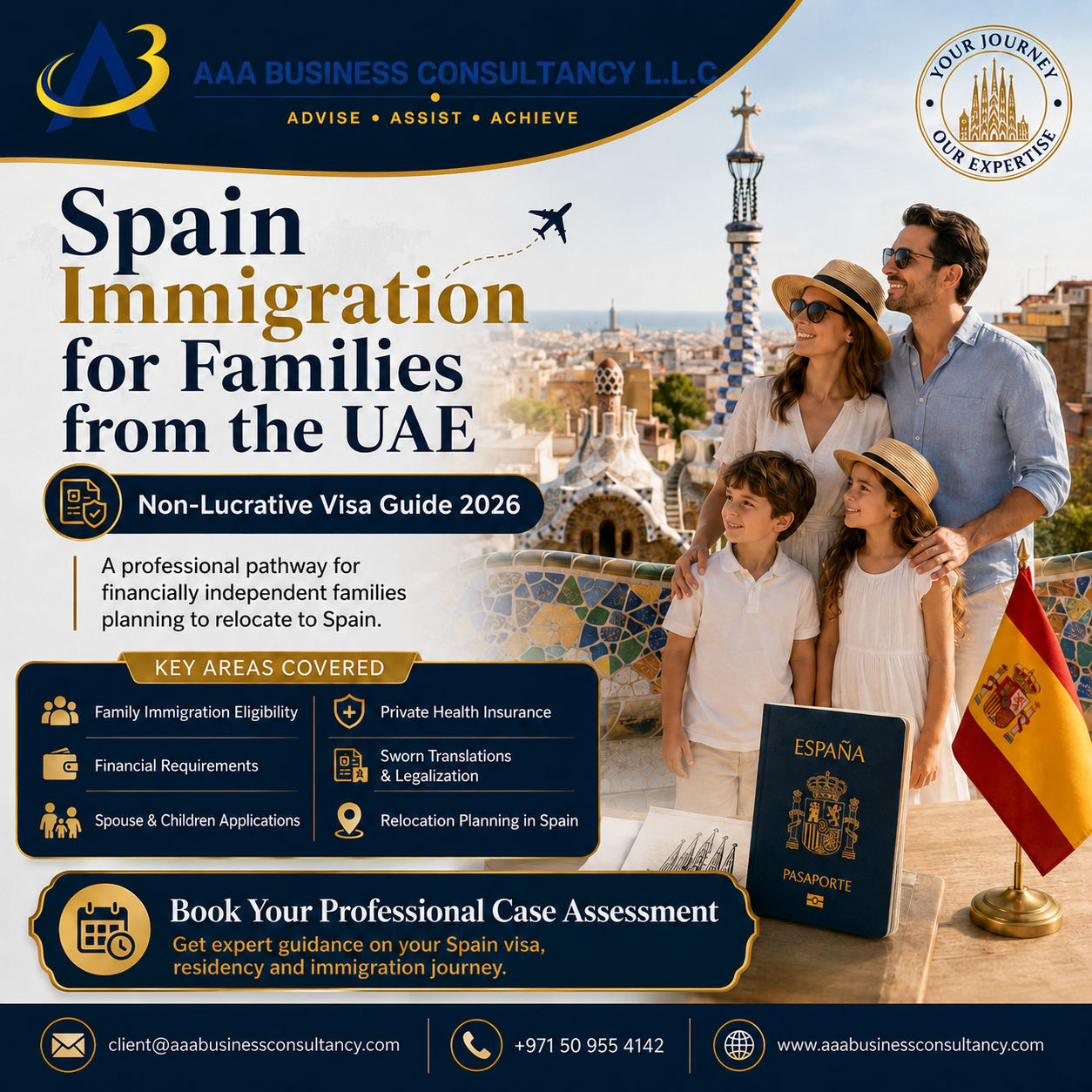
Moving to Spain with your family is a significant decision that requires careful immigration, financial, documentation and relocation planning.
For financially independent families living in Dubai or elsewhere in the UAE, the Spain Non-Lucrative Visa, commonly known as the NLV, may provide a suitable immigration pathway. It allows eligible non-EU nationals and qualifying family members to reside in Spain without carrying out employment or professional activities.
However, a successful family application involves considerably more than demonstrating the minimum amount in a bank account. Applicants must establish that the Non-Lucrative Visa is the correct immigration route, that sufficient financial resources are genuinely available, and that every family member meets the applicable health insurance, medical, legal and documentation requirements.
This guide explains the main Spain immigration requirements for UAE-based families considering the Non-Lucrative Visa in 2026.
What Is the Spain Non-Lucrative Visa?
The Spain Non-Lucrative Visa is an immigration and residence pathway for non-EU nationals who wish to live in Spain without undertaking employment, self-employment or professional activities.
Under Spain’s current immigration regulations, non-lucrative temporary residence may be granted to a qualifying foreign applicant and eligible family members who can support themselves in Spain without working. The initial residence authorization is generally valid for one year. (BOE)
The NLV may be suitable for families supported by:
- Personal savings
- Pension income
- Rental income
- Investment income
- Dividends
- Fixed deposits
- Other reliable passive income
- A combination of savings and recurring non-employment income
The Non-Lucrative Visa is not a remote-work visa. An applicant who intends to continue working online, providing consultancy services, managing a business actively or carrying out freelance work from Spain should obtain professional immigration guidance before selecting this route.
Depending on the applicant’s employment arrangements, Spain’s Digital Nomad Visa or another immigration category may be more appropriate.
Why UAE Families Consider Immigration to Spain
Spain is an attractive relocation destination for families seeking a European lifestyle, a diverse cultural environment and access to different education and residential options.
Families considering Spain immigration may be attracted by:
- European residence opportunities
- International, bilingual and Spanish schools
- Universities and professional training institutions
- Opportunities for children to learn Spanish
- Established transportation and public infrastructure
- A wide selection of cities, coastal areas and family communities
- Access to different cultural and educational experiences
- The possibility of progressing towards longer-term residence, subject to eligibility
Madrid and Barcelona offer extensive international connections and educational options, while cities such as Valencia, Málaga, Alicante and Seville may appeal to families seeking different lifestyles and living environments.
The appropriate city will depend on the family’s housing budget, preferred schools, climate, transportation needs, language preferences and long-term objectives.
Who Can Apply from the UAE?
Applicants normally submit a Spain Non-Lucrative Visa application through the Spanish consular authorities responsible for their place of legal residence.
UAE-based applicants must therefore demonstrate that they are legally resident in the UAE. Their nationality, UAE residence status and previous countries of residence may affect the documents required for the immigration application.
According to the Embassy of Spain in Abu Dhabi, Non-Lucrative Visa applications from the UAE must currently be submitted in person at the BLS Spain Visa Application Centre in Dubai. An appointment is required, and the applications are not submitted at the BLS premises in Abu Dhabi. (Ministry of Foreign Affairs)
Every family member must generally have an individual application file, even when all applicants are applying together as one family.
Which Family Members Can Be Included?
Under the current Spanish immigration regulations, the following qualifying family members may be included with the principal applicant:
- A spouse
- A registered partner
- A stable partner whose relationship is properly demonstrated
- Unmarried minor children who have not formed their own family unit
- Certain adult children who require support because of a disability or health condition that prevents them from providing for their own needs
For a stable partnership, the current regulation refers to evidence of a durable relationship. A continuous period of marital-style cohabitation of at least one year may demonstrate the relationship, although this period is not required where the couple has children together and can establish a stable relationship. (BOE)
Each family relationship must be properly documented. Depending on the circumstances, evidence may include:
- Marriage certificates
- Birth certificates
- Registered-partnership certificates
- Evidence of cohabitation
- Joint residential records
- Evidence of children in common
- Custody documents
- Parental authorization
- Medical or disability documentation
- Evidence that an adult child cannot support themselves independently
Cases involving unmarried partners, adult dependants, previous marriages, children travelling with one parent or inconsistencies between civil-status documents should be reviewed carefully before submission.
Financial Requirements for Families in 2026
Financial capacity is one of the most important elements of the Spain Non-Lucrative Visa immigration process.
The principal applicant must demonstrate financial resources equal to at least 400% of the monthly IPREM. An additional 100% of the monthly IPREM is required for every accompanying family member. These resources must cover the complete period of the requested residence authorization. (Inclusión y Migraciones)
Spain’s official monthly IPREM for 2026 is €600. (Social Security España)
Based on this figure, the indicative minimum amounts are:
| Family composition | Monthly minimum | Minimum for 12 months |
|---|---|---|
| Main applicant only | €2,400 | €28,800 |
| Main applicant and one family member | €3,000 | €36,000 |
| Main applicant and two family members | €3,600 | €43,200 |
| Main applicant and three family members | €4,200 | €50,400 |
| Main applicant and four family members | €4,800 | €57,600 |
| Main applicant and five family members | €5,400 | €64,800 |
For example, a married couple with two children would generally need to demonstrate at least €50,400 for the initial one-year authorization.
These are minimum immigration thresholds. They should not be confused with the family’s complete relocation budget. Applicants may also need funds for housing deposits, rent, private health insurance, schooling, translations, legalization procedures, travel and post-arrival expenses.
Financial thresholds and consular practices should always be checked again before submitting an application.
Is Meeting the Minimum Financial Requirement Enough?
Holding the minimum amount does not automatically mean that a family’s immigration application is ready for submission.
The authorities may consider whether the funds are:
- Genuinely owned or controlled by the applicants
- Readily accessible
- Sufficient for the entire family
- Supported by consistent financial records
- Obtained from a lawful and credible source
- Available without the applicants working in Spain
- Compatible with the family’s stated circumstances
A large balance supported by incomplete or inconsistent evidence may raise questions. Similarly, substantial deposits made shortly before an immigration application may require a clear explanation and supporting documentation.
The financial evidence should tell a coherent story about the family’s resources, income, savings and ability to live in Spain without undertaking employment or professional activities.
What Financial Evidence Can Be Submitted?
The appropriate evidence will depend on how the family intends to support itself in Spain.
Supporting documents may include:
- Personal bank statements
- Bank balance certificates
- Savings-account records
- Fixed-deposit certificates
- Pension statements
- Rental agreements
- Bank statements showing rental payments
- Dividend statements
- Investment-account records
- Property-ownership documents
- Evidence of company ownership
- Relevant tax documents
- Evidence explaining major transfers or deposits
- A financial summary or explanatory cover letter
Spain’s current regulations permit applicants to demonstrate either sufficient financial resources for the residence period or a regular source of income. For foreign accounts, the authorities may seek details such as the identity of the financial institution, account information, the previous year-end balance and the average balance during the previous year. (BOE)
A family relying on rental income, for example, may need to provide ownership documents, tenancy contracts, proof of regular rental payments and evidence that the income is expected to continue.
A family relying primarily on savings should be able to demonstrate that the funds are genuinely available and have not been temporarily borrowed or transferred solely for the immigration application.
Can the Spouse’s Funds Be Used?
A family’s financial resources may be held by the principal applicant, the spouse or both applicants.
Where a significant part of the money is held in the spouse’s name, the application should clearly demonstrate:
- The marital or partnership relationship
- Ownership of the funds
- The source of the money
- The spouse’s access to the funds
- The availability of the money for the whole family
- How the funds will support the family in Spain
Joint accounts may help demonstrate shared access, but they do not replace the need to explain the source, stability and availability of the funds.
The financial presentation should be prepared as one coordinated family immigration file.
Can Employment Income Be Used?
The Non-Lucrative Visa is intended for residence without carrying out employment or professional activities.
A current salary may help explain an applicant’s financial history, but applicants should not assume that continuing active employment after relocating to Spain is compatible with the NLV.
Before applying, the principal applicant should review:
- Current employment contracts
- Remote-work arrangements
- Consultancy agreements
- Freelance activities
- Company-management responsibilities
- Business ownership and active involvement
- The nature of continuing income
- Activities planned after moving to Spain
An applicant who intends to continue working remotely may need to consider Spain’s Digital Nomad Visa rather than the Non-Lucrative Visa.
Selecting an immigration pathway that does not match the applicant’s actual activities can create risks during the application or renewal process.
Private Health Insurance for the Whole Family
Every applicant must have suitable health insurance for Spain.
The insurance must be arranged with a public or private insurer authorized to operate in Spain. The policy must provide the healthcare coverage required for the residence application. (Inclusión y Migraciones)
Families should confirm:
- That every applicant is named on the policy
- That coverage applies throughout Spain
- The policy’s effective date
- The complete coverage period
- Whether the policy contains copayments
- Whether waiting periods apply
- Whether there are important exclusions
- Whether annual coverage limits apply
- How pre-existing medical conditions are treated
- Whether the insurer can provide the required certificate
Travel insurance should not automatically be treated as equivalent to private residence health insurance.
The policy should be reviewed for immigration compliance as well as the family’s actual healthcare needs.
Main Documents Required
The final checklist must be confirmed according to the current UAE procedure and each applicant’s circumstances.
A family application will generally include the following documents.
National visa application form
Each applicant must complete and sign an individual national visa application form.
For a minor applicant, the form must be signed by a parent, legal guardian or properly authorized representative.
EX-01 residence application form
Every applicant must complete the official EX-01 form for the initial temporary non-lucrative residence authorization. (Inclusión y Migraciones)
Passport
Applicants must provide a valid passport or travel document recognized by Spain.
The official immigration guidance requires a passport with a minimum validity of one year. (Inclusión y Migraciones)
Passport photograph
A recent photograph meeting the applicable visa photograph requirements must be submitted.
Proof of UAE legal residence
Applicants must demonstrate that they are legally residing within the consular jurisdiction.
Proof of sufficient financial resources
The principal applicant must provide evidence covering their own financial requirement and the additional amount required for every accompanying family member.
Private health insurance
Suitable Spanish health insurance must be provided for every applicant.
Criminal-record certificates
Adult applicants must generally provide criminal-record certificates from their country of origin and from countries where they have resided during the previous five years. (Inclusión y Migraciones)
The applicable validity, legalization and translation requirements should be checked before obtaining these certificates.
Medical certificate
Applicants must provide a medical certificate confirming that they do not suffer from diseases that could have serious public-health consequences under the International Health Regulations of 2005. (Inclusión y Migraciones)
The required wording and document-authentication process should be confirmed before the certificate is issued.
Family relationship documents
Marriage, birth, partnership, custody or dependency documents must be submitted where relevant.
Application fees
The applicable visa and residence-authorization fees must be paid in accordance with the current procedure. Fees and payment arrangements should be verified before the appointment.
Documents for a Spouse or Partner
A spouse or partner requires an individual immigration application supported by evidence of the relationship.
The file may include:
- Marriage certificate
- Registered-partnership certificate
- Evidence of a stable relationship
- Proof of cohabitation
- Joint residential records
- Evidence of children in common
- Joint financial records
- Additional declarations or supporting evidence
Names, dates and personal information must be consistent across passports, certificates and application forms.
Differences caused by name changes, transliteration or previous marriages should be explained and supported by the appropriate documents.
Documents for Children
Each child must have a separate application.
The child’s file may include:
- Passport
- Birth certificate
- Health-insurance certificate
- Financial-support evidence
- Medical certificate where required
- Custody documents
- Parental consent
- Evidence relating to schooling plans
- Proof of relationship to the principal applicant
Where a child will travel or relocate with only one parent, the family may need to provide consent from the other parent or documentation establishing the relevant custody arrangements.
Adult children can only qualify in limited circumstances under the current regulations. Strong medical, disability and dependency evidence may be necessary. (BOE)
Apostille, Legalization and Spanish Sworn Translation
Foreign public documents often require authentication before being accepted in a Spanish immigration process.
Depending on the issuing country and document type, a document may need:
- Issuance in the correct original format
- Authentication by the appropriate national authority
- An apostille under the Hague Convention or consular legalization
- Translation into Spanish
- Submission of the original, authentication and translation together
Official immigration guidance states that foreign documents must generally be translated into Spanish or the relevant co-official language by a sworn translator. Foreign public documents must also be legalized or apostilled unless an applicable international agreement provides an exemption. (Inclusión y Migraciones)
Documents that may require these procedures include:
- Marriage certificates
- Birth certificates
- Police-clearance certificates
- Partnership certificates
- Divorce judgments
- Custody orders
- Medical documents
- Dependency documents
- Certain public financial records
The order in which legalization and translation are completed matters. Families should confirm the correct process before arranging translations.
Why Family Applications Need a Coordinated Immigration Strategy
A family NLV case should be prepared as one coordinated immigration application.
The individual files should be consistent regarding:
- Family composition
- Financial resources
- Intended residence in Spain
- Expected travel dates
- Health-insurance coverage
- Relationship documents
- Employment status
- Relocation objectives
- Schooling plans
- Sources of income
- The intention not to work in Spain
Problems can arise when family members provide different information or supporting documents that do not align.
Examples include:
- Different Spanish addresses appearing in separate applications
- Insufficient funds for all dependants
- Names that do not match across passports and civil records
- Different health-insurance commencement dates
- Employment evidence that conflicts with the NLV conditions
- Missing custody or consent documents
- Weak evidence of a stable partnership
- Unexplained recent deposits
- Different intended travel dates without an explanation
A coordinated review can identify inconsistencies before the family attends its submission appointment.
Spain Immigration Application Process from the UAE
Step 1: Determine whether the NLV is appropriate
The family should review its finances, employment arrangements, family composition and relocation plans.
The first question should not simply be whether the family holds enough money. It should be whether the NLV is the correct immigration pathway.
Step 2: Calculate the complete financial requirement
The calculation must include the principal applicant and every accompanying family member.
Families should also prepare a separate relocation budget covering housing, insurance, schooling and post-arrival costs.
Step 3: Review the source and structure of the funds
The applicants should identify which accounts, savings, investments or passive-income sources will support the application.
Any unusual transactions or recent deposits should be explained.
Step 4: Obtain family and civil-status documents
Marriage, birth, partnership, custody and dependency documents should be obtained in the correct format.
Step 5: Complete legalization and translation
Foreign public documents should be apostilled or legalized and translated into Spanish where required.
Step 6: Arrange private health insurance
Every applicant must have appropriate coverage for Spain.
The policy dates should be coordinated with the family’s immigration and travel plans.
Step 7: Complete the application forms
Each family member must have an individual national visa form and EX-01 residence application.
Step 8: Book the BLS appointment in Dubai
The family must arrange an appointment and follow the current submission instructions for the BLS Spain Visa Application Centre in Dubai. (Ministry of Foreign Affairs)
Step 9: Attend the appointment
The applications should be submitted in the required format and order.
Applicants should carry original documents and the required copies.
Step 10: Respond to additional requests
The consular authorities may request further documents, explanations or an interview.
Applicants should respond within the stated deadline and ensure that new information remains consistent with the original application.
Step 11: Review the visas after approval
Every family member’s visa should be checked carefully for:
- Correct name
- Passport number
- Visa type
- Validity dates
- Number of entries
- Any observations or conditions
Errors should be reported before travel.
What Happens After Approval?
The Embassy of Spain in Abu Dhabi states that the Non-Lucrative Visa is valid for 90 days. After entering Spain, the residence holder must apply for a Foreigner Identity Card within one month of entry. (Ministry of Foreign Affairs)
The post-arrival immigration and administrative process may include:
- Registering the residential address through the empadronamiento
- Paying the applicable TIE fee
- Booking fingerprint appointments
- Attending the police appointments
- Applying for the TIE
- Collecting the residence cards
- Registering children in school
- Opening local bank accounts
- Arranging telephone and utility services
- Obtaining a Digital Certificate or Cl@ve where appropriate
The family should begin planning these procedures before travelling, particularly when accommodation or school admission deadlines are involved.
Schooling Considerations for Families
Families relocating with children should research schools before finalizing their Spanish destination.
Spain offers different education options, including:
- Spanish public schools
- Concertado schools
- Private schools
- International schools
- Bilingual programmes
- Vocational and professional training institutions
Parents should consider the child’s age, curriculum, preferred language of instruction, admission schedule, location, fees and transportation arrangements.
Academic records may also require translation or legalization depending on the institution and admission procedure.
For renewal of the Non-Lucrative Residence authorization, children of compulsory school age must have been properly enrolled during their residence in Spain. (Inclusión y Migraciones)
Renewal of the Family’s Non-Lucrative Residence
The initial Non-Lucrative Residence authorization is generally valid for one year. (BOE)
A renewal application may normally be submitted during the two months before the authorization expires. It can also be submitted during the three months following expiry, although late submission may result in administrative consequences. (Inclusión y Migraciones)
For renewal, the family must continue to demonstrate:
- Sufficient financial resources
- Continued health-insurance coverage
- Compliance with the NLV conditions
- School attendance for children of compulsory school age
- Payment of the applicable fee
- Genuine and effective residence in Spain for more than 183 days during the calendar year
Under the regulations currently in force, the renewed authorization is generally valid for two years unless the applicant qualifies for long-term residence or another residence category. (BOE)
Because renewal normally covers two years, the financial requirement for the renewal period can be significantly higher than for the initial one-year authorization.
Families should therefore consider renewal planning from the beginning of their immigration journey.
Common Immigration Mistakes in Family NLV Applications
Frequent mistakes include:
- Selecting the NLV while intending to continue active employment
- Calculating funds only for the principal applicant
- Failing to include every dependant
- Presenting unexplained recent bank deposits
- Providing inconsistent financial documents
- Failing to establish ownership or accessibility of funds
- Purchasing unsuitable health insurance
- Obtaining certificates too early and allowing them to expire
- Missing apostille or legalization requirements
- Using an unsuitable translation
- Providing weak partnership evidence
- Failing to demonstrate an adult child’s eligibility
- Missing custody or parental-consent documents
- Using inconsistent information across family applications
- Ignoring renewal and residence requirements
- Making irreversible relocation commitments before visa approval
A general checklist cannot identify every immigration risk. Each family application must be assessed according to the applicants’ nationalities, UAE residence status, financial arrangements, employment situation and family circumstances.
How AAA Business Consultancy Supports Families
AAA Business Consultancy L.L.C. provides professional Spain visa, residency, immigration and relocation assistance for individuals and families based in the UAE.
Our support may include:
- Initial immigration eligibility review
- Professional Case Assessment
- Selection of the appropriate Spain immigration pathway
- Family application planning
- Financial-requirement calculations
- Review of savings and passive-income evidence
- Personalized document checklists
- Identification of missing documents and potential risks
- Review of spouse, partner and dependant documentation
- Application-form assistance
- Health-insurance guidance
- Apostille and legalization guidance
- Coordination of Spanish sworn translations
- Pre-submission document review
- Post-approval relocation assistance
- Guidance regarding NIE, TIE, empadronamiento, Digital Certificate and other procedures in Spain
Every family’s circumstances are different. Professional assessment can help applicants understand whether the NLV is suitable and how their financial, family and immigration documents should be prepared.
Begin Your Family’s Spain Immigration Journey
The Spain Non-Lucrative Visa can provide a valuable immigration pathway for financially independent families seeking to establish a new life in Spain without working.
However, successful preparation requires more than meeting a minimum financial amount.
The family must demonstrate that:
- The NLV is the correct immigration pathway
- Sufficient financial resources are genuinely available
- The source of the funds is clear and credible
- Every family member has suitable health insurance
- Family relationships are properly documented
- Foreign documents are correctly authenticated and translated
- All individual applications are complete and consistent
- The family understands the post-arrival and renewal requirements
Before submitting your application, arrange a Professional Case Assessment with AAA Business Consultancy L.L.C.
Our team will review your family’s circumstances, identify potential immigration risks and provide a personalized action plan for your Spain visa, residency and relocation journey.
AAA Business Consultancy L.L.C.
Spain Visa, Residency and Immigration Services
Email: client@aaabusinessconsultancy.com
Telephone and WhatsApp: +971 50 955 4142
Website: www.aaabusinessconsultancy.com
Advise • Assist • Achieve.