Spain Residency and Immigration Requirements for UAE Residents
Planning to Move from the UAE to Spain?
Spain continues to attract UAE residents seeking new professional opportunities, access to European markets, quality education, an attractive lifestyle, and long-term residency options.
Applying for a Spanish visa or residency permit requires careful preparation. The exact process and supporting documents depend on several factors, including:
- The selected visa or residency category
- The applicant’s nationality
- UAE residency status
- Employment or business circumstances
- Financial position
- Family situation
- Intended activities in Spain
- Place of application
Understanding the visa, residency, and immigration requirements before beginning the process can help applicants avoid incomplete submissions, unnecessary delays, additional costs, and possible refusal.
Who Can Apply for Spanish Residency from the UAE?
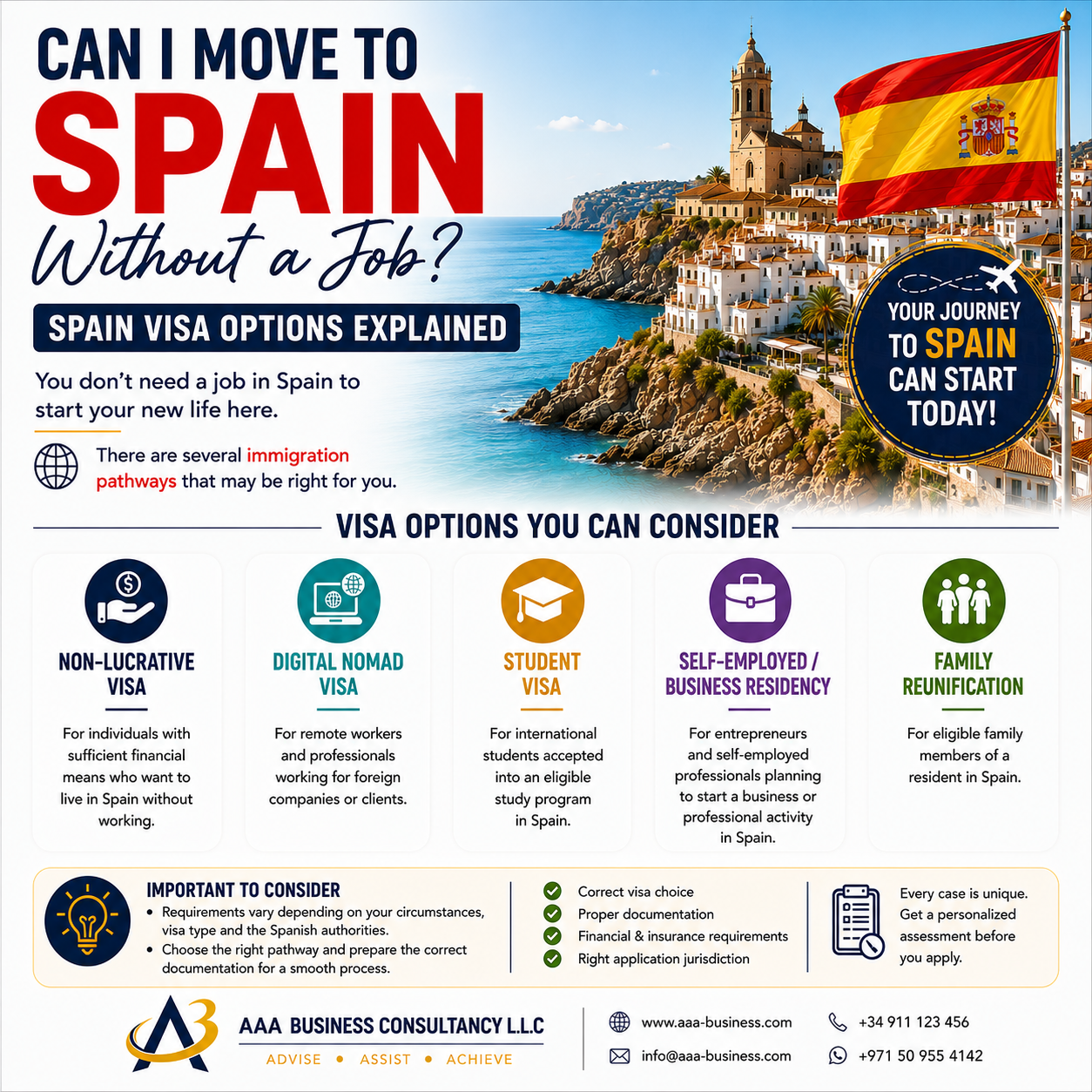
UAE residents may be eligible for different Spanish visa, residency, and immigration pathways depending on their qualifications, income, employment structure, family circumstances, and intended activities in Spain.
Available pathways may include:
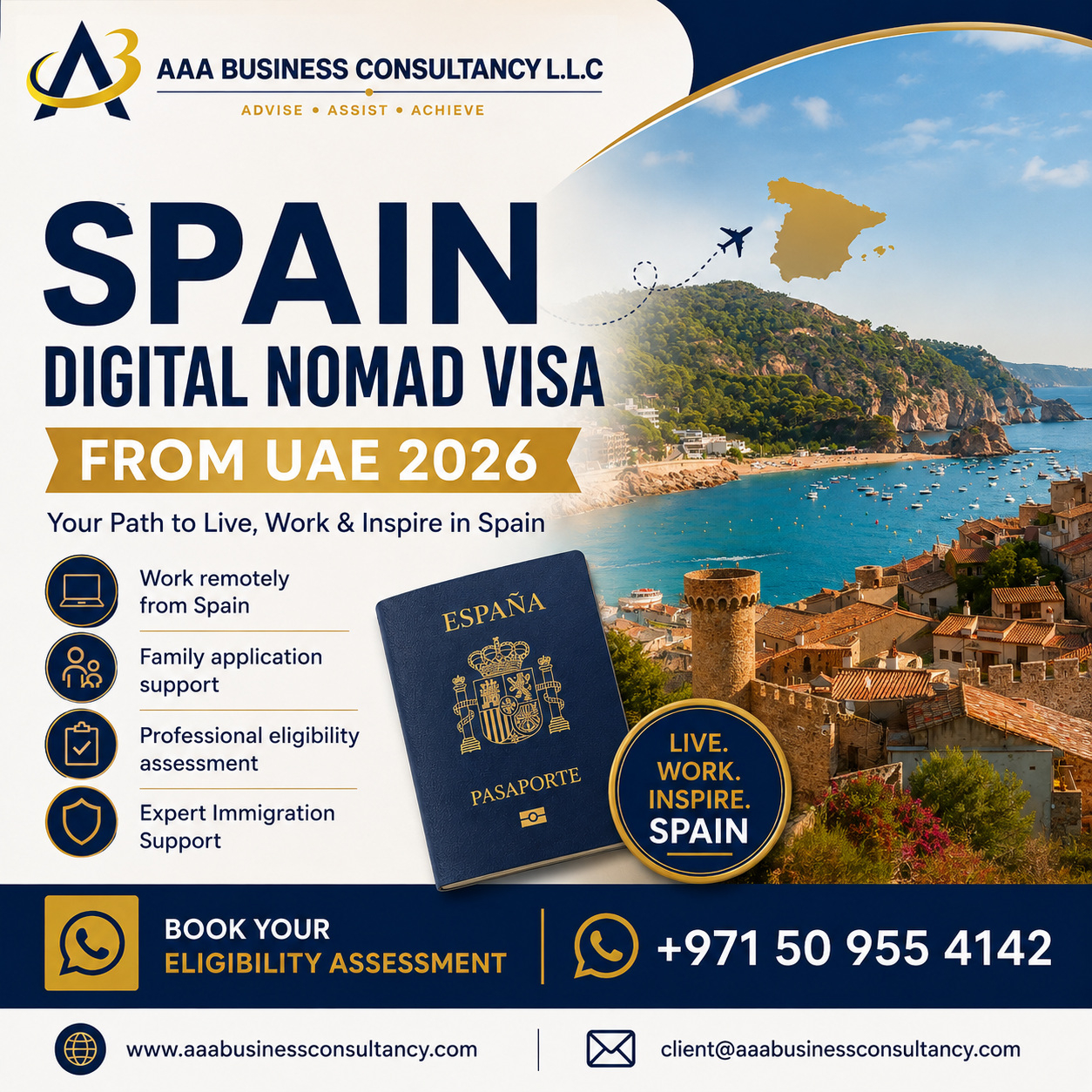
- Spain Digital Nomad Visa
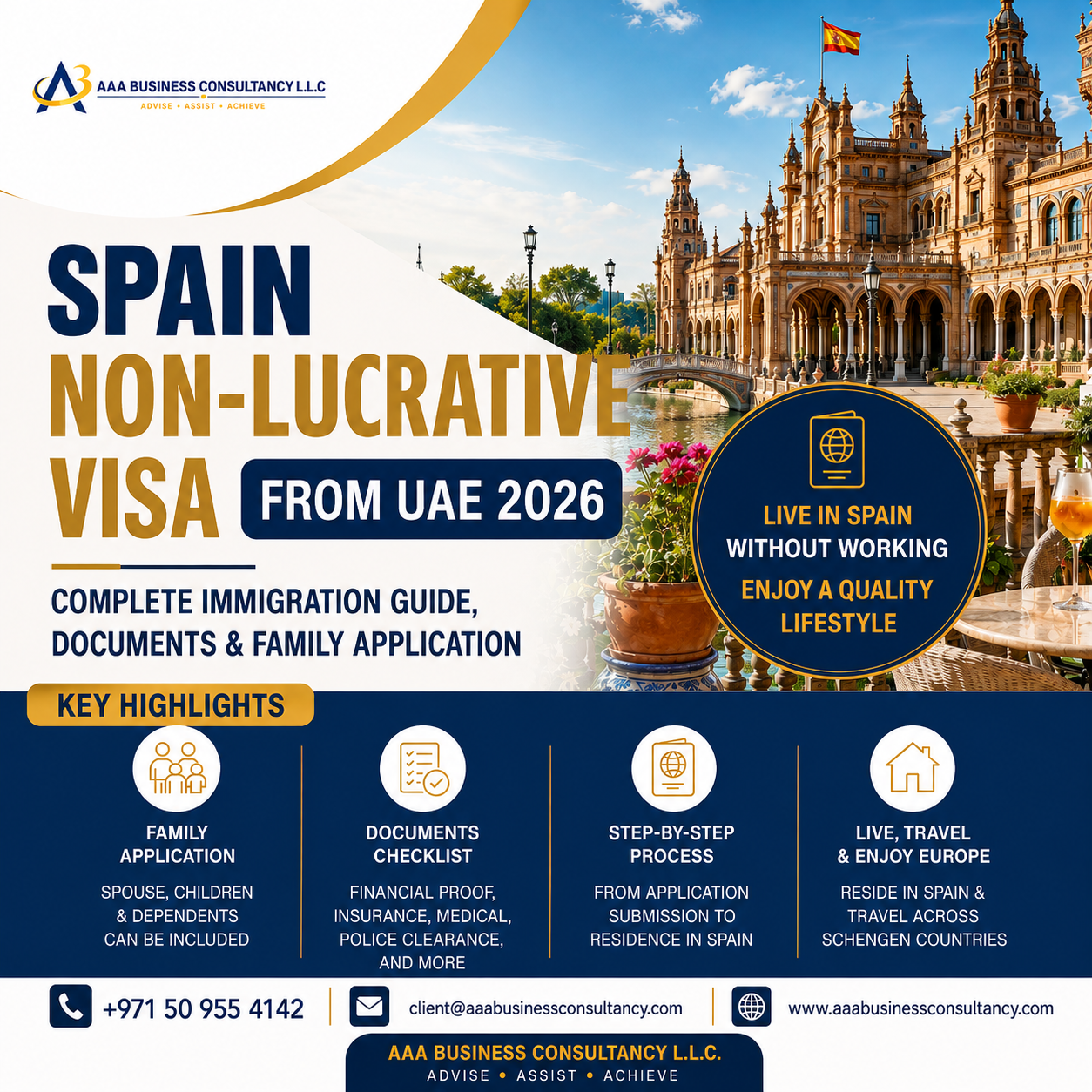
- Spain Non-Lucrative Visa
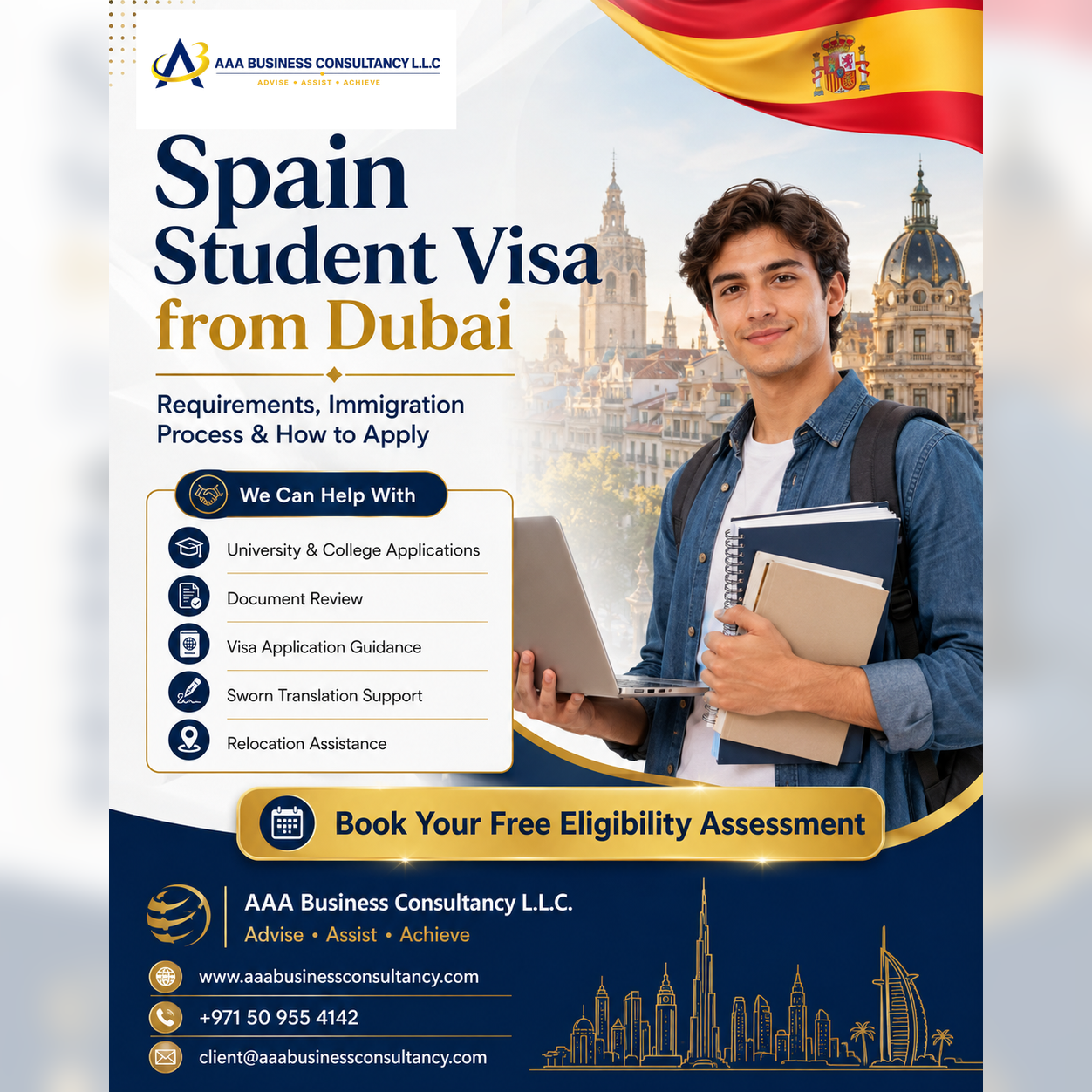
- Spain Student Visa
- Employment and Work Residence
- Highly Qualified Professional Residence
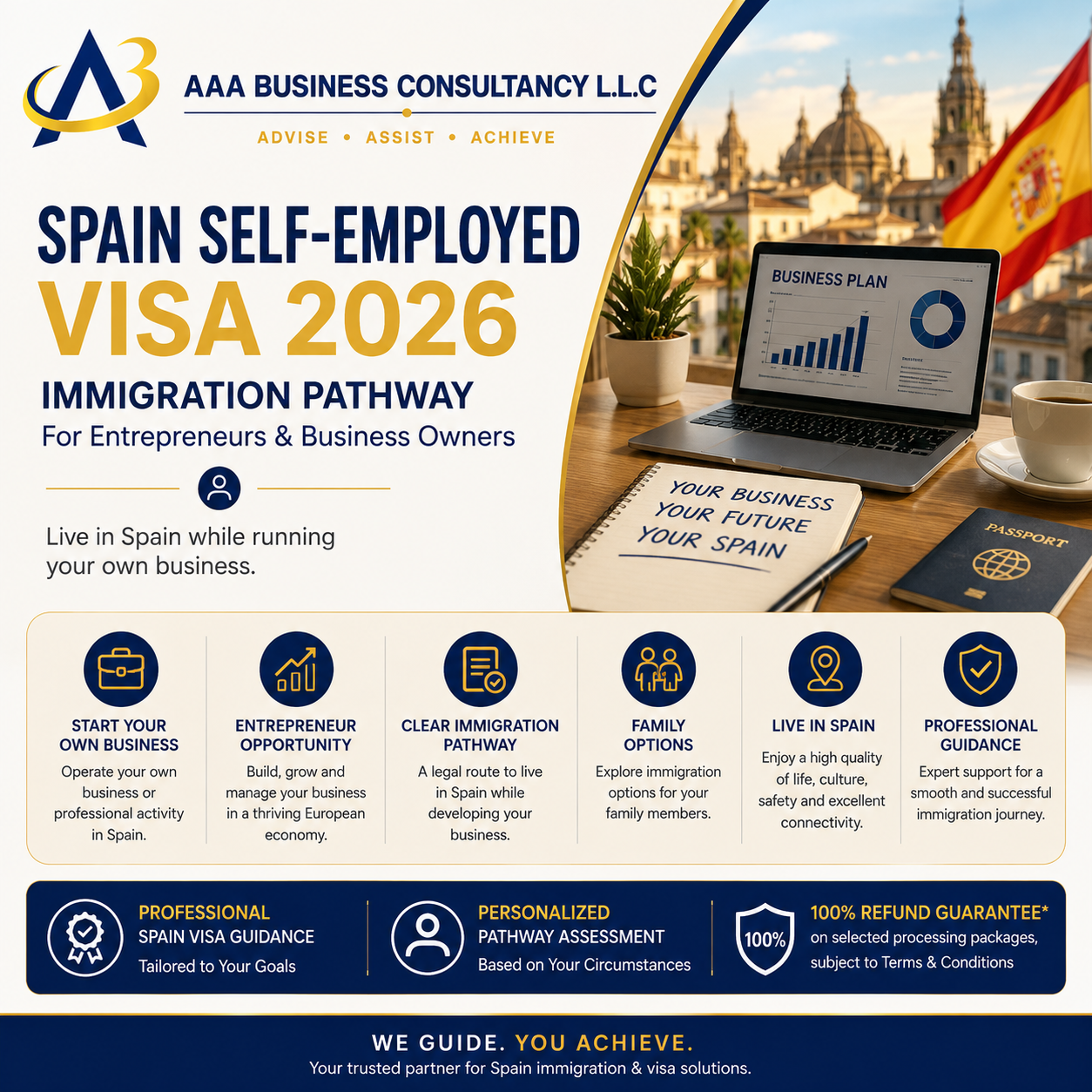
- Entrepreneur Residence
- Self-Employed Residence
- Family Reunification
- Residence for Family Members of Spanish or EU Citizens
- Long-Term Residence
- Residence Renewals and Modifications
Each pathway has its own eligibility criteria, financial requirements, immigration procedures, and supporting documents.
Selecting the correct legal pathway is one of the most important steps when applying for a Spain visa from Dubai or elsewhere in the UAE.
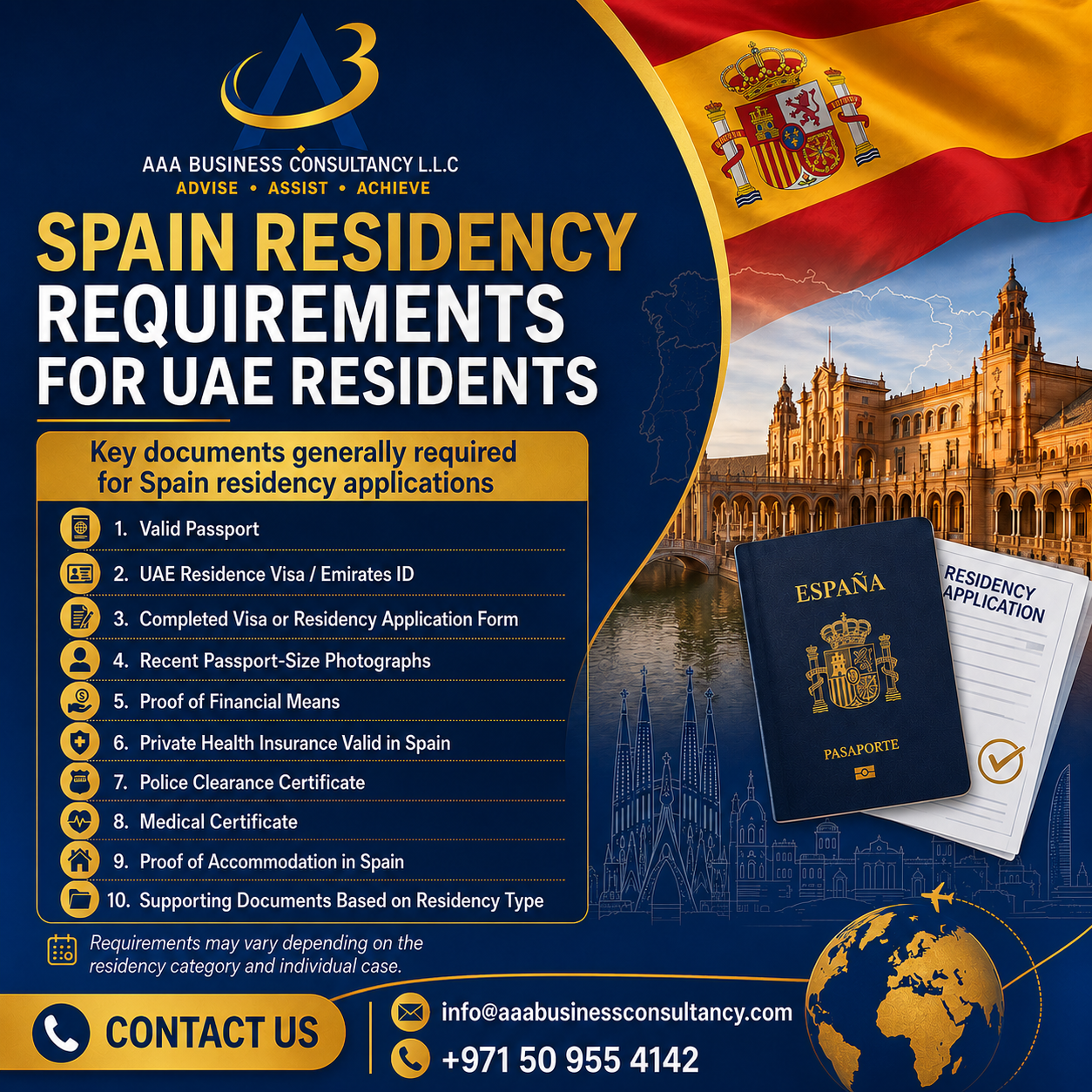
General Spain Residency Requirements for UAE Residents
Although the requirements vary depending on the selected visa or residency category, applicants are generally expected to provide the following documents.
1. Valid Passport
The applicant must hold a valid passport that meets the requirements of the selected visa or residency category.
The passport should:
- Be in good condition
- Contain sufficient blank pages
- Be signed by the holder, where applicable
- Remain valid for the required period
- Match the personal information provided in the application
Copies of the identification page and other relevant passport pages may also be required.
2. UAE Residence Visa or Emirates ID
Applicants submitting a Spanish visa or residency application from the UAE may need to prove that they are legally residing in the country.
This may include:
- A valid UAE residence visa
- A valid Emirates ID
- Copies of the relevant passport residency pages
- Additional proof of legal residence, where required
The applicant’s UAE residency should normally remain valid during the application process.
3. Completed Visa or Residency Application Form
The correct application form must be completed accurately and signed by the applicant.
Applicants should ensure that:
- All mandatory sections are completed
- Names and personal details match the passport
- Employment and financial details are accurate
- The correct visa or residency category is selected
- The form is signed in the required places
Using the wrong form or providing inconsistent information may lead to delays or additional document requests.
4. Recent Passport-Size Photographs
Applicants are generally required to submit recent photographs that meet the applicable biometric requirements.
The photographs should be:
- Recent
- Clear and professionally taken
- In the correct size
- Taken against the required background
- Compliant with the relevant authority’s specifications
5. Proof of Financial Means
Applicants must normally demonstrate that they have sufficient financial resources to support themselves during their residence in Spain.
The required amount depends on the selected residency category and the number of accompanying family members.
Financial evidence may include:
- Personal bank statements
- Salary certificates
- Employment contracts
- Pension statements
- Proof of savings
- Business income records
- Investment or rental income evidence
- Sponsorship documents, where accepted
- Proof of regular and stable income
The evidence should be clear, consistent, verifiable, and sufficient for the applicant’s circumstances.
6. Private Health Insurance Valid in Spain
Many Spanish residency categories require private medical insurance from an insurance provider authorized to operate in Spain.
The policy may need to provide:
- Comprehensive healthcare coverage
- Coverage throughout Spain
- Coverage for the required residency period
- Conditions suitable for the selected visa or residency category
A standard travel insurance policy may not be sufficient for a long-term Spanish residency application.
7. Police Clearance Certificate
Adult applicants may be required to provide a police clearance or criminal record certificate from the relevant countries where they have lived during the applicable period.
Depending on the country of issuance, the certificate may need to be:
- Apostilled
- Legalized or attested
- Issued within the required validity period
- Translated into Spanish
- Submitted in its original form
Applicants who have lived in several countries may need police clearance certificates from more than one jurisdiction.
8. Medical Certificate
A medical certificate may be required to confirm that the applicant meets the applicable health requirements.
The medical certificate may need:
- Specific wording
- The doctor’s signature and stamp
- Verification by the relevant authorities
- Legalization or attestation
- An official Spanish translation
Applicants should confirm the required format before obtaining the certificate.
9. Proof of Accommodation in Spain
Depending on the residency category and application stage, applicants may need to provide evidence of accommodation in Spain.
Accepted evidence may include:
- A rental agreement
- Property ownership documents
- A hotel or temporary accommodation booking
- An invitation or accommodation declaration
- Confirmation from an educational institution
- Other acceptable accommodation evidence
10. Supporting Documents Based on the Residency Type
Every Spanish visa and residency category has its own specific supporting-document requirements.
For example:
- Digital Nomad Visa applicants may need remote employment contracts, professional agreements, company documents, qualifications, and evidence of professional experience.
- Non-Lucrative Visa applicants may need strong evidence of sufficient savings, passive income, pension income, rental income, or other financial resources.
- Student Visa applicants may need an admission letter, study programme information, tuition-payment evidence, accommodation documents, and proof of sufficient financial support.
- Employment Visa applicants may need an employment contract, employer documents, and the applicable work authorization.
- Entrepreneur applicants may need a detailed and viable business plan together with supporting professional and financial evidence.
- Family applicants may need marriage certificates, birth certificates, dependency evidence, and documents proving the family relationship.
Spanish Immigration Procedures After Arrival
Receiving a Spanish visa is not always the final step. Depending on the type and duration of the authorization, applicants may need to complete additional immigration and administrative procedures after arriving in Spain.
These may include:
Foreigner Identity Number—NIE
The NIE is an identification number assigned to foreign nationals who have financial, professional, administrative, or legal interests in Spain.
It may be required for matters such as:
- Property transactions
- Banking
- Employment
- Tax registration
- Business activities
- Government procedures
Foreigner Identity Card—TIE
The TIE is the physical residence card issued to eligible non-EU foreign residents in Spain.
Depending on the authorization, the applicant may need to:
- Book a fingerprint appointment
- Complete the relevant application form
- Pay the applicable administrative fee
- Submit passport photographs
- Present the visa or residence approval
- Collect the card after processing
Empadronamiento
The empadronamiento is registration with the local municipality where the person resides.
It may be required for various administrative procedures, including residence-card applications, healthcare matters, education, and other local services.
Digital Certificate and Cl@ve
A Spanish digital certificate or Cl@ve access can help residents complete certain government procedures online.
These systems may be used for:
- Immigration notifications
- Tax procedures
- Social Security services
- Municipal procedures
- Checking application status
- Accessing government records
NIF and Tax Registration
Depending on the applicant’s activities and circumstances, tax registration may be necessary after relocating to Spain.
This can be particularly relevant for:
- Employees
- Self-employed professionals
- Business owners
- Property owners
- Individuals receiving foreign income
- Digital nomads
Professional tax advice should be obtained where necessary because tax residence and immigration residence are separate matters.
Social Security and Healthcare Registration
Applicants who are entitled to access Spain’s public healthcare or Social Security system may need to complete the relevant registration procedures.
Requirements depend on the person’s immigration status, employment position, insurance coverage, and eligibility.
Family Reunification
Eligible Spanish residents may later be able to apply for certain family members to join them in Spain.
Family reunification applications may require:
- Proof of the qualifying family relationship
- Birth or marriage certificates
- Proof of sufficient financial resources
- Suitable accommodation evidence
- Valid residence documentation
- Legalized and translated civil-status documents
Residency Renewals and Modifications
Temporary residence permits normally have validity periods. Applicants should review their renewal requirements early and avoid waiting until the last moment.
Depending on the circumstances, it may also be possible to modify one type of residence authorization into another, subject to eligibility and immigration requirements.
Legalization, Attestation, and Spanish Translation
Foreign documents are not always accepted in Spain in their original form.
Depending on the issuing country and type of document, applicants may need to complete one or more of the following procedures:
- Apostille
- Consular legalization
- Ministry attestation
- Spanish sworn translation
- Certification of copies
- Verification of document validity
Submitting a document without the required legalization, attestation, or translation may result in delays or rejection of the document.
Applicants should also check whether documents have limited validity periods, particularly police clearance certificates, medical certificates, and financial documents.
Why a Professional Immigration Case Assessment Is Important
Submitting an application is not simply about collecting a standard list of documents. Applicants must select the appropriate pathway, demonstrate eligibility, and prepare their supporting evidence according to their individual circumstances.
Before proceeding, applicants should identify:
- The most suitable visa or residency pathway
- Whether they meet the eligibility requirements
- Which documents are mandatory
- Which additional evidence may strengthen the application
- Whether documents require legalization or attestation
- Whether Spanish sworn translation is required
- Whether the application is ready for submission
- Which immigration procedures will be required after arrival
- Which risks or missing documents should be addressed first
At AAA Business Consultancy L.L.C., our Professional Case Assessment may include:
- A dedicated one-to-one consultation
- A professional evaluation of eligibility
- Identification of the most suitable visa or residency pathway
- An initial review of available documents
- A personalized document checklist
- Identification of required and missing documents
- Guidance regarding legalization and Spanish translation
- An application-readiness assessment
- A personalized step-by-step action plan
- An estimated processing timeline
- Guidance regarding post-arrival immigration procedures
- A recommendation for the appropriate processing package
Common Immigration and Residency Mistakes to Avoid
Applicants should avoid:
- Selecting an unsuitable visa or residency category
- Submitting incomplete application forms
- Providing expired documents
- Using insufficient health insurance
- Submitting unclear or inconsistent financial evidence
- Failing to obtain police certificates from all relevant countries
- Submitting documents without the required legalization or attestation
- Using unofficial or unacceptable translations
- Providing inconsistent employment or personal information
- Missing immigration appointments
- Failing to complete fingerprint or residence-card procedures
- Missing renewal deadlines
- Applying without confirming the case-specific requirements
Careful preparation can reduce the risk of delays, additional document requests, unnecessary costs, and refusal.
Spain Visa, Residency, and Immigration Services
AAA Business Consultancy L.L.C. provides professional assistance to individuals and families planning to apply for Spanish visas and residency from Dubai and other emirates in the UAE.
Our services may include:
- Professional Case Assessment
- Visa and residency pathway guidance
- Personalized document checklists
- Document preparation and verification
- Legalization and attestation guidance
- Spanish sworn translation coordination
- Application-form assistance
- Application-readiness review
- End-to-end visa and residency processing
- Family reunification assistance
- Residence renewal guidance
- NIE assistance
- TIE and fingerprint appointment assistance
- Empadronamiento assistance
- Digital Certificate and Cl@ve assistance
- NIF and tax-registration coordination
- Social Security and healthcare registration assistance
- Administrative and relocation assistance in Spain
Our objective is to help applicants understand the immigration process, prepare the correct supporting evidence, and proceed under the most suitable Spanish visa or residency pathway.
Start Your Spain Immigration Journey with Professional Guidance
A Spanish residency application involves more than completing a form. The correct immigration pathway must be selected, eligibility must be evaluated, supporting documents must be properly prepared, and post-arrival procedures must be completed where applicable.
Because every applicant’s profile is different, the exact requirements should be confirmed through a professional, case-specific assessment.
For a Spain Visa from Dubai, Contact AAA Business Consultancy L.L.C.
📧 client@aaabusinessconsultancy.com
📞 +971 50 955 4142
🌐 www.aaabusinessconsultancy.com
AAA Business Consultancy L.L.C.
Advise • Assist • Achieve