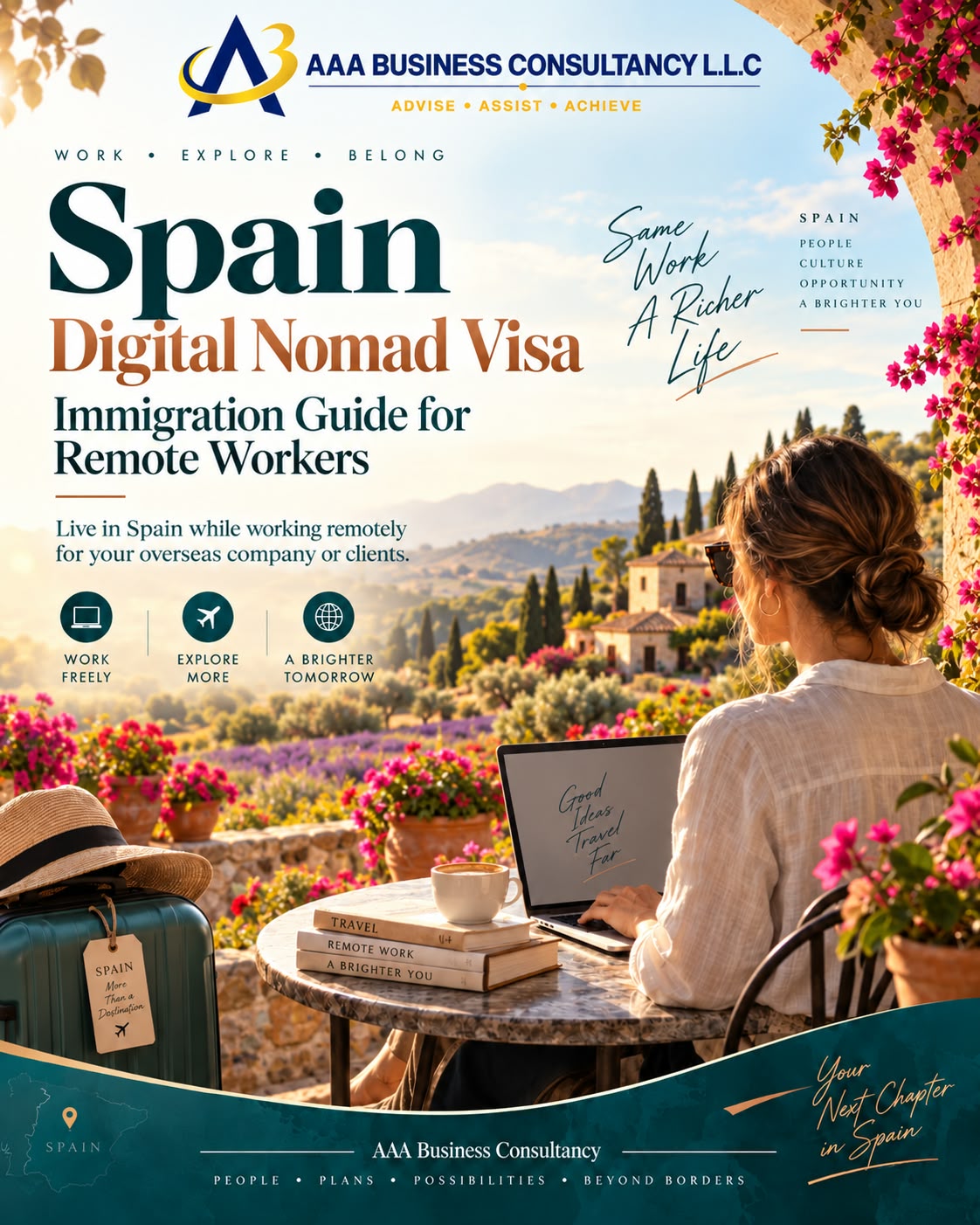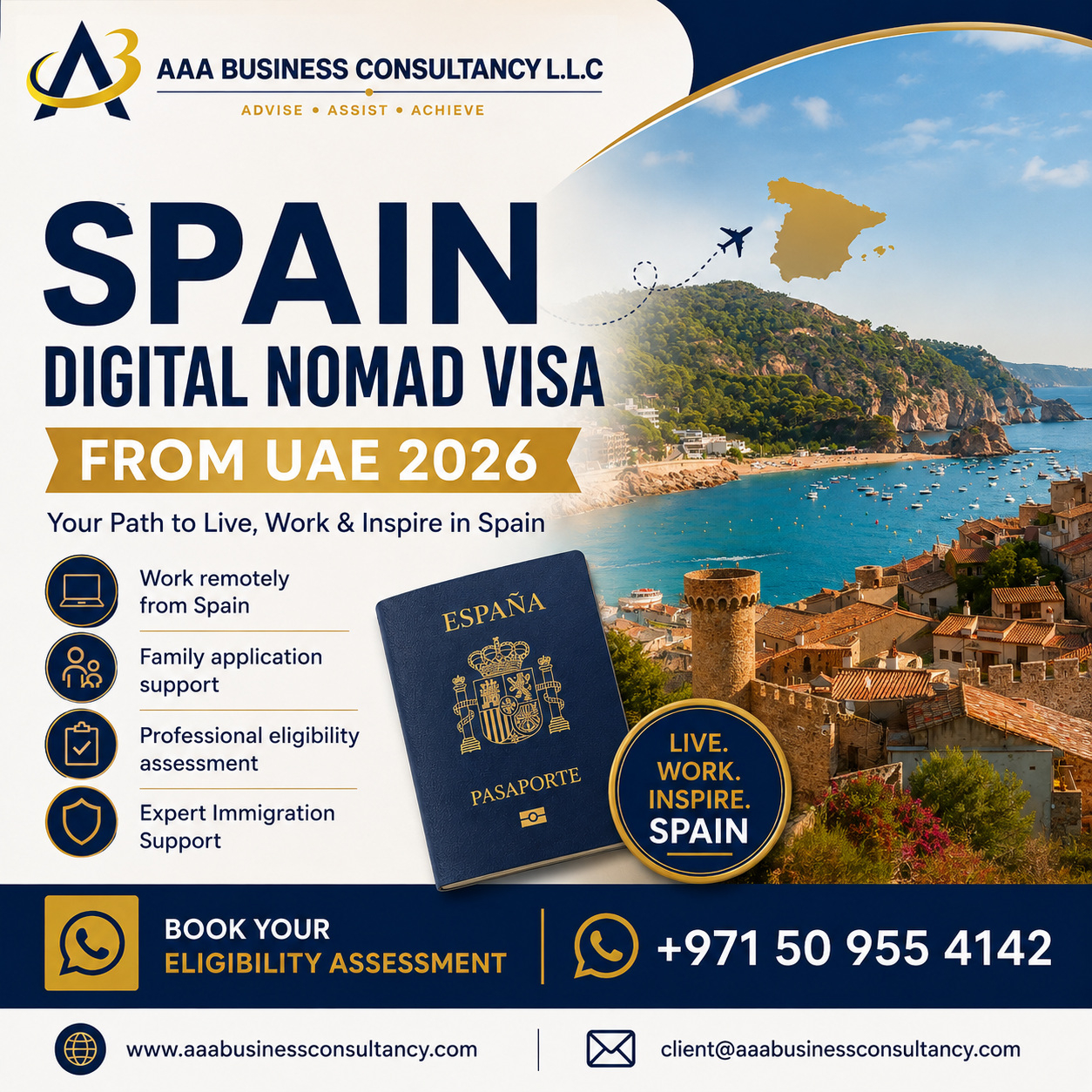
The Spain Digital Nomad Visa from UAE 2026 provides an immigration pathway for qualifying non-EU nationals who want to live in Spain while continuing their professional activity remotely.
However, working remotely alone does not automatically make someone eligible.
Applicants must satisfy specific requirements relating to their employment or professional relationship, company activity, income, qualifications, immigration history, documentation, health coverage, and—in certain cases—Social Security arrangements.
This guide explains the Spain Digital Nomad Visa from UAE 2026, including eligibility, financial requirements, family applications, documents, application options, and important issues applicants should consider before starting the immigration process.
What Is the Spain Digital Nomad Visa?
Spain’s Digital Nomad Visa is officially connected to the residence category for international teleworkers.
It was introduced into Spain’s immigration framework following changes made by Spain’s Startup Law and allows qualifying third-country nationals to reside in Spain while carrying out professional activities remotely using computer, telecommunications, and digital systems. (BOE)
The visa is particularly relevant to:
- Remote employees
- IT professionals
- Consultants
- Digital marketing professionals
- Designers
- Software developers
- Engineers
- Managers
- Online professionals
- Freelancers
- Consultants working with overseas clients
- Certain business owners who can properly demonstrate their professional relationship and activity
The individual circumstances of the applicant remain extremely important.
Who Can Apply for the Spain Digital Nomad Visa from UAE 2026?
The Spain Digital Nomad Visa from UAE 2026 may be suitable for a non-EU national legally residing in the UAE who performs qualifying work remotely.
Spain distinguishes between an employee and an independent professional or freelancer.
Remote Employees
For an employee, the work must be performed for a company located outside Spain.
Spanish law states that, in the case of an employment relationship, an international teleworker may work only for companies established outside Spain. (BOE)
The applicant must generally demonstrate that:
- The foreign company genuinely exists and has been carrying out real and continuous activity for at least one year.
- The applicant has maintained the employment relationship for at least the three months immediately before the application.
- The applicant’s work can genuinely be performed remotely.
- The employer permits the employee to perform the job remotely from Spain.
These requirements are expressly reflected in Spain’s legislation governing international teleworkers. (BOE)
Freelancers and Independent Professionals
Freelancers may also qualify.
For a professional relationship, applicants generally need to demonstrate a commercial relationship with one or more companies located outside Spain for at least the previous three months and show the conditions under which the professional activity will continue remotely. (BOE)
One important difference applies to freelancers.
A qualifying professional may perform some work for a company located in Spain, but this activity cannot exceed 20% of the applicant’s total professional activity. (BOE)
Qualification or Professional Experience Requirement
Having sufficient income is not the only eligibility requirement.
Applicants must also demonstrate appropriate professional qualifications.
A qualifying applicant should generally be able to demonstrate either:
- A graduate or postgraduate qualification from a recognized university;
- Recognized professional or vocational training;
- Education from a recognized business school; or
- At least three years of relevant professional experience.
Spain’s legislation specifically provides these qualification and professional-experience routes for international teleworkers. (BOE)
This is an important part of the immigration assessment because applicants should be able to connect their education or professional experience to the remote activity they intend to perform from Spain.
Spain Digital Nomad Visa Financial Requirements for 2026
Financial capacity is one of the most important parts of the application.
Spain uses the Salario Mínimo Interprofesional (SMI), or minimum interprofessional wage, when calculating the financial requirement.
Spain’s official SMI for 2026 is €1,221 per month in 14 payments, equivalent to €17,094 annually. (BOE)
Current official consular guidance applies the following percentages:
- Main applicant: 200% of the SMI
- First accompanying family member: 75% of the SMI
- Each additional family member: 25% of the SMI (Ministry of Foreign Affairs, Spain)
Based on the 2026 SMI, this means approximately:
| Applicant | 2026 Financial Benchmark |
|---|---|
| Main applicant | €2,442/month |
| First dependent | + €915.75/month |
| Each additional dependent | + €305.25/month |
Official Spanish consular guidance currently identifies approximately €2,442 per month for the principal applicant. (Ministry of Foreign Affairs, Spain)
Example: Main Applicant + Spouse
Approximately:
€2,442 + €915.75 = €3,357.75 per month
Example: Main Applicant + Spouse + One Child
Approximately:
€2,442 + €915.75 + €305.25 = €3,663 per month
Example: Main Applicant + Spouse + Two Children
Approximately:
€3,968.25 per month
Financial calculations should always be checked again immediately before submitting an application because statutory salary levels and consular calculations can change.
Can Family Members Apply Together?
Yes.
Eligible family members may accompany the principal Digital Nomad Visa applicant.
Depending on the relationship and circumstances, this may include:
- Spouse
- Registered or qualifying partner
- Minor children
- Financially dependent adult children who have not created their own family unit
- Dependent ascendants in qualifying circumstances
Spanish consular guidance expressly recognizes accompanying family members under the international teleworker category. (Ministry of Foreign Affairs, Spain)
The applicant must also provide appropriate evidence proving the family relationship and, where relevant, financial dependency.
Documents Commonly Required
Every immigration application should be prepared according to the applicant’s particular circumstances.
However, a Spain Digital Nomad Visa from UAE 2026 application may commonly involve documents such as:
- Valid passport
- National visa application form
- Passport photographs
- UAE residence documentation
- Employment contract or professional agreements
- Employer letter
- Remote-work authorization
- Evidence that the foreign company has operated for at least one year
- Evidence of the applicant’s relationship with the company or clients for the required period
- Bank statements
- Salary evidence
- Payslips where applicable
- Professional qualification certificates
- Evidence of at least three years of professional experience where qualification is based on experience
- Criminal record certificates
- Health insurance documentation
- Social Security documentation where applicable
- Marriage certificate for a spouse
- Birth certificates for children
- Evidence of dependency where applicable
The Spanish Embassy in Abu Dhabi maintains a specific Digital Nomad Visa category, while the official BLS Spain Visa Application Centre in the UAE lists Teleworker (TEL) & Relatives among Spain’s national visa categories. (BLS Spain Visa UAE)
Apostille, Legalization and Spanish Translation
One of the most common immigration-document problems is assuming that a document can simply be submitted because it was officially issued in another country.
Depending on the country that issued the document and the type of document, it may require:
- Apostille;
- Legalization;
- Spanish translation; or
- Additional authentication.
Spanish consular instructions state that foreign documents may need to be translated into Spanish and properly legalized or apostilled. (Ministry of Foreign Affairs, Spain)
Applicants should determine these requirements before preparing the final application package.
Incorrect legalization or translation can create unnecessary delays.
Does the Employer Need to Approve Remote Work from Spain?
This can be a crucial point.
An employment contract simply saying that a person works remotely may not always provide enough evidence.
Spanish legislation requires documentation showing that the employment or professional relationship can be performed remotely. For employees, the foreign company must also permit the employee to carry out the work remotely. (BOE)
Therefore, employer documentation should clearly support the proposed working arrangement.
A professional immigration review should examine the wording of the employment contract and employer authorization before submission.
How Long Must the Foreign Company Have Been Operating?
The company or group of companies connected to the applicant must demonstrate real and continuous activity for at least one year.
This requirement is stated directly in Article 74 ter of Spain’s Law 14/2013. (BOE)
This requirement can be particularly important for applicants who work for newly incorporated businesses.
Simply registering a company shortly before the application may therefore not satisfy the underlying requirement.
How Long Must You Have Worked for the Company?
Generally, the relevant employment or professional relationship must have existed for at least three months before the application.
For employees, this relates to their employment relationship with the foreign company.
For independent professionals, it concerns the commercial relationship with one or more foreign companies. (BOE)
Applicants should therefore carefully review contract dates, salary records and supporting evidence before filing.
Can You Apply from the UAE?
Yes, qualifying residents can pursue the Digital Nomad Visa through Spain’s applicable consular process.
The official UAE Spain Visa Application Centre currently includes Teleworker (TEL) & Relatives under its national visa categories. (BLS Spain Visa UAE)
Applicants should follow the current submission procedure applicable to their place of legal residence and verify the latest appointment, documentation and consular requirements before filing.
Can Someone Apply from Inside Spain?
There is another important immigration route.
Foreign nationals who are legally present in Spain may, where they satisfy the conditions, apply directly for an international telework residence authorization.
Spanish legislation distinguishes this residence authorization from the consular Digital Nomad Visa. (BOE)
The appropriate strategy therefore depends on factors including:
- Where the applicant is currently located
- Immigration status
- Nationality
- Timing
- Family circumstances
- Professional documentation
- Intended period of residence
Applicants should not automatically assume that one route is always better than the other.
Visa Versus Residence Authorization
The two procedures should not be confused.
The international telework visa can generally have a maximum validity of one year, unless the intended work period is shorter.
By comparison, the residence authorization available in Spain may have a validity of up to three years, subject to the period of qualifying work and continued eligibility. (BOE)
Eligible residence authorizations can subsequently be renewed for periods of two years if the conditions continue to be satisfied. (BOE)
Common Digital Nomad Visa Mistakes
A strong application is not simply a collection of documents.
Some common problems include:
- Choosing the wrong immigration pathway
- Employer letter not clearly authorizing remote work from Spain
- Insufficient evidence that the company has operated for at least one year
- Employment relationship shorter than the required period
- Inconsistent salary information
- Bank statements that do not correspond with declared income
- Incorrect financial calculations for dependants
- Missing criminal record certificates
- Incorrect apostille or legalization
- Documents not properly translated into Spanish
- Professional experience not properly demonstrated
- Job duties not clearly compatible with remote work
- Problems relating to Social Security documentation
- Inconsistencies between contracts, company documents and salary evidence
Many of these issues can be identified before filing through a detailed professional eligibility assessment.
Is the Digital Nomad Visa the Same as the Non-Lucrative Visa?
No.
These are different Spanish immigration pathways.
The Digital Nomad Visa is designed for qualifying international remote workers and professionals.
The Non-Lucrative Residence Visa is designed around residence in Spain without carrying out work under that residence category.
Applicants should therefore not select a visa only because they meet the financial requirement.
Their professional activity, source of income, intended activities in Spain, family circumstances and long-term objectives should all be considered before choosing an immigration route.
Is the Digital Nomad Visa the Same as a Tourist Visa?
No.
A tourist or Schengen visa is intended for temporary short stays.
The Digital Nomad Visa belongs to Spain’s national immigration framework and is intended for qualifying residence and international remote-working activity.
Someone planning to relocate to Spain should therefore assess the appropriate residence category instead of relying on repeated short-term visits.
Health Insurance and Social Security
Health coverage and Social Security require careful case-by-case assessment.
The correct documents can depend on whether the applicant is:
- An employee
- A freelancer
- A company owner
- Covered by a foreign Social Security system
- Required to register within the Spanish system
These issues should be reviewed before submission rather than addressed only after the immigration application has already been prepared.
What About Tax in Spain?
Immigration residence and tax residence are not the same question.
Obtaining a Spanish residence authorization does not mean every applicant will have exactly the same tax treatment.
Tax consequences can depend on factors such as:
- Number of days spent in Spain
- Source of income
- Employment structure
- Company ownership
- Personal circumstances
- Applicable international tax agreements
- Eligibility for any particular Spanish tax regime
Anyone planning long-term residence in Spain should obtain appropriate tax advice based on their individual circumstances.
Why Professional Immigration Planning Matters
A Digital Nomad Visa case may initially appear straightforward:
remote job + sufficient income = visa
In practice, the assessment is considerably more detailed.
Spanish authorities may need to understand:
- Who employs you
- Where the company is located
- How long the company has operated
- How long you have worked with the company
- Whether your work can genuinely be performed remotely
- Whether your employer has authorized you to work from Spain
- Your qualifications or experience
- Your financial capacity
- Your family circumstances
- Your documentation history
- Your insurance and Social Security position
Professional immigration planning helps ensure that these different elements support one consistent application.
Professional Eligibility Assessment
Before beginning the full application process, AAA Business Consultancy can conduct a Professional Eligibility Assessment of the applicant’s circumstances and supporting documentation.
The assessment can help identify:
- Whether the Digital Nomad Visa is the appropriate pathway
- Eligibility issues
- Financial requirements
- Employer-document requirements
- Missing supporting documents
- Potential weaknesses
- Family application requirements
- Translation and legalization requirements
- Application preparation priorities
- Recommended next steps
This allows applicants to understand their case before committing to the complete immigration process.
Planning to Apply for the Spain Digital Nomad Visa from UAE 2026?
The Spain Digital Nomad Visa from UAE 2026 can provide an excellent immigration pathway for qualifying remote professionals, freelancers and their families who want to build a new life in Spain while maintaining international professional activity.
However, successful immigration planning starts with confirming eligibility before submitting documents.
Every applicant has a different employment structure, income profile, nationality, family situation and documentation history.
AAA Business Consultancy provides professional assistance with:
- Spain visa and residency eligibility assessment
- Digital Nomad Visa applications
- Non-Lucrative Visa applications
- Study Visa applications
- Self-Employed and business residency
- Family applications
- Document preparation
- Sworn translation coordination
- Immigration application support
- Post-arrival administrative and relocation assistance in Spain
Start Your Spain Immigration Journey
AAA Business Consultancy L.L.C.
🌐 www.aaabusinessconsultancy.com
📧 client@aaabusinessconsultancy.com
Advise • Assist • Achieve.
Note: Immigration requirements, financial thresholds and administrative procedures can change. Applicants should confirm the requirements applicable to their individual circumstances at the time of submission.