SEO Title: Spain Digital Nomad Visa vs Non-Lucrative Visa from Dubai and the UAE in 2026
Meta Description: Compare the Spain Digital Nomad Visa and Non-Lucrative Visa from Dubai and the UAE in 2026. Understand work rights, financial requirements, family options, documents and the most suitable Spain immigration pathway.
Primary Keyword: Spain Digital Nomad Visa vs Non-Lucrative Visa
Supporting Keywords: Spain immigration from Dubai, Spain visa from UAE, Spain residency for UAE residents, move to Spain from Dubai, Spain Digital Nomad Visa requirements, Spain Non-Lucrative Visa requirements
Suggested URL: /spain-digital-nomad-visa-vs-non-lucrative-visa-uae-2026/
Spain Digital Nomad Visa vs Non-Lucrative Visa: Which Immigration Route Is Right for You?
Moving from Dubai or another emirate to Spain can offer a new lifestyle, long-term residence opportunities and access to one of Europe’s most attractive destinations.
However, choosing the correct Spain visa and immigration pathway is essential.
Two of the most popular residence options for UAE residents are:
- The Spain Digital Nomad Visa
- The Spain Non-Lucrative Visa
Although both routes may allow eligible non-EU nationals to reside legally in Spain, they are designed for very different types of applicants.
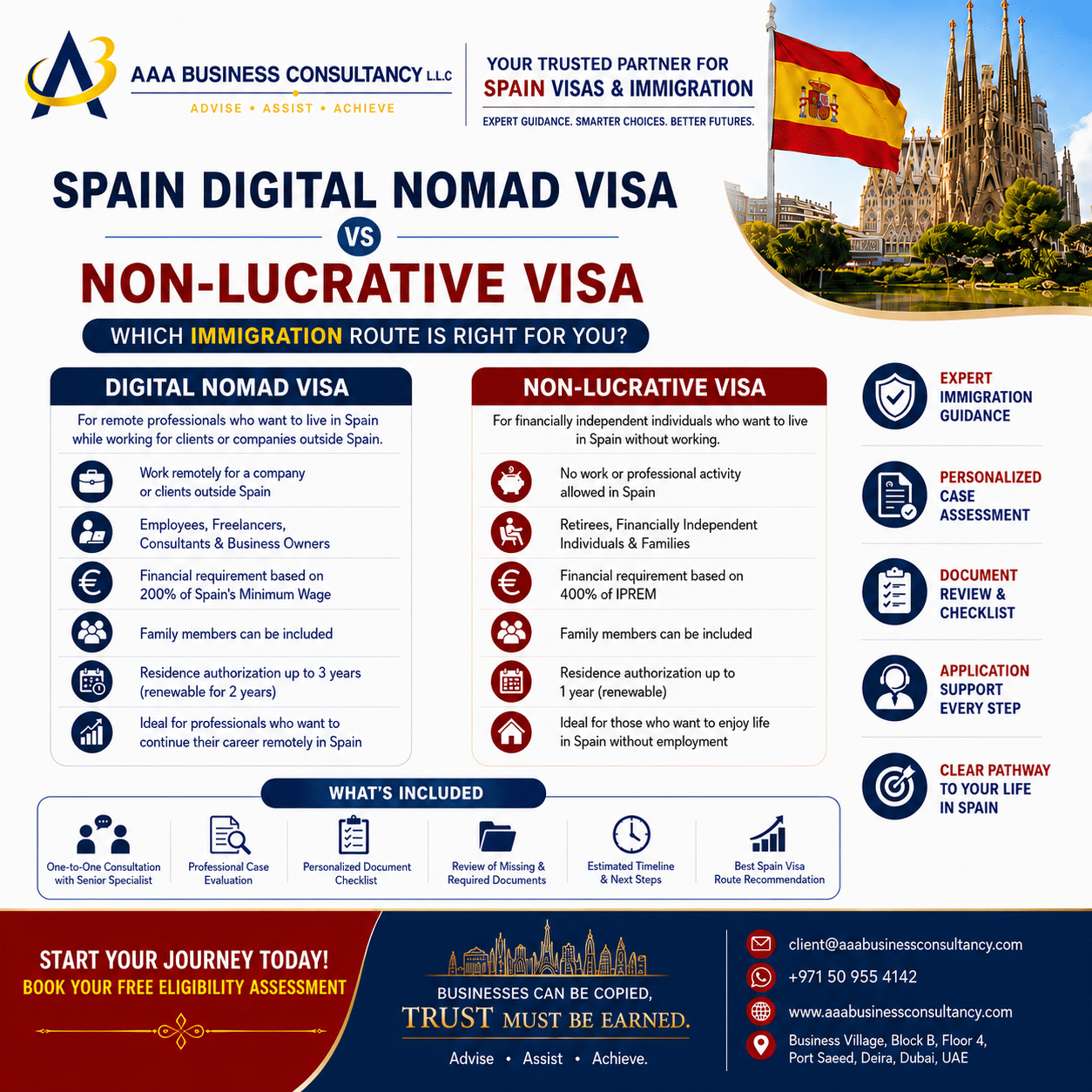
The Digital Nomad Visa is generally intended for remote professionals who continue working for companies or clients located mainly outside Spain. The Non-Lucrative Visa is designed for applicants who have sufficient financial resources and intend to live in Spain without carrying out employment or professional activity. (Ministry of Foreign Affairs)
This guide explains the principal differences, requirements, family options and factors UAE residents should consider before applying.
What Is the Spain Digital Nomad Visa?
The Spain Digital Nomad Visa is an immigration route for eligible non-EU nationals who want to live in Spain while carrying out remote employment or professional activity using digital and telecommunications systems.
It is primarily intended for people working for businesses located outside Spain, including:
- Remote employees
- Freelancers
- Consultants
- Certain business owners
- Independent professionals with overseas clients
Spain introduced this immigration category through the Startup Law framework. The applicable legislation defines international teleworkers as third-country nationals who move to Spain to perform remote employment or professional activity for companies established outside Spanish territory. (Inclusión y Migraciones)
For employed applicants, the work must generally be performed for a company located outside Spain.
Self-employed professionals may carry out a limited amount of professional activity for Spanish clients, provided that the Spanish activity does not exceed 20% of their total professional activity. (Ministry of Foreign Affairs)
What Is the Spain Non-Lucrative Visa?
The Spain Non-Lucrative Visa, also known as the non-working residence visa, allows eligible non-EU nationals to live in Spain without undertaking employment or professional activity.
Applicants must demonstrate sufficient and guaranteed financial resources to support themselves and any accompanying family members.
The Non-Lucrative Visa does not provide permission to work. It is therefore generally more appropriate for:
- Retired applicants
- Financially independent individuals
- Applicants supported by savings or passive income
- Families with sufficient financial resources
- People who do not need to work while residing in Spain
The Spanish Embassy in Abu Dhabi describes this category as a visa for residing in Spain without carrying out any gainful work or professional activity. (Ministry of Foreign Affairs)
Main Differences Between the Digital Nomad Visa and Non-Lucrative Visa
| Requirement | Digital Nomad Visa | Non-Lucrative Visa |
|---|---|---|
| Main purpose | Live in Spain while working remotely | Live in Spain without working |
| Employment allowed | Remote work under the qualifying conditions | No employment or professional activity |
| Typical applicant | Remote employee, freelancer or consultant | Retiree or financially independent applicant |
| Source of funds | Remote employment or professional income | Savings, passive income or other reliable resources |
| Foreign company relationship | Normally required | Not required |
| Professional qualifications | Degree, professional training or qualifying experience | Generally not based on professional qualifications |
| Spanish clients | Limited possibility for eligible self-employed applicants | Not permitted as professional activity |
| Family applications | Eligible relatives may apply | Eligible relatives may apply |
| Financial benchmark | Based on Spain’s minimum wage | Based on IPREM |
| Application focus | Employment, company, income and remote-work evidence | Financial means and proof that the applicant will not work |
Who Should Consider the Spain Digital Nomad Visa?
The Digital Nomad Visa may be suitable when an applicant:
- Works remotely for a company outside Spain
- Has an established employment or professional relationship
- Can continue performing the work from Spain
- Receives sufficient income
- Can demonstrate appropriate qualifications or experience
- Wants to continue an international career while residing in Spain
Applicants must generally demonstrate that they are qualified professionals. This may be established through a recognised graduate or postgraduate qualification, qualifying professional training or at least three years of relevant professional experience. (Ministry of Foreign Affairs)
Evidence may also be required to show that the applicant has worked for, or maintained a professional relationship with, the relevant foreign company or clients for at least three months before applying. (Ministry of Foreign Affairs)
For an employee, documentation commonly includes confirmation of:
- The length of the employment relationship
- The employee’s salary
- The employer’s permission to work remotely from Spain
- The company’s business activity and establishment
- The terms under which remote work will be performed
For a self-employed applicant, evidence may include professional contracts, invoices, client relationships and confirmation of the conditions under which the activity will be carried out remotely.
Who Should Consider the Spain Non-Lucrative Visa?
The Non-Lucrative Visa may be more appropriate when an applicant:
- Does not intend to work in Spain
- Has sufficient savings or regular passive income
- Is retired or financially independent
- Wants to relocate with eligible family members
- Can maintain private health insurance
- Is prepared to make Spain their principal place of residence
This route is not suitable for someone whose financial plan depends on continuing employment or freelance work while living in Spain.
Even when the applicant works entirely online for a foreign company, remote work may conflict with the purpose of the Non-Lucrative Visa. Applicants who intend to continue working should therefore assess whether the Digital Nomad Visa is the more appropriate immigration pathway.
Financial Requirements for the Digital Nomad Visa
Applicants for the Digital Nomad Visa must demonstrate sufficient financial resources.
For the main applicant, the required amount is based on 200% of Spain’s monthly minimum wage.
For accompanying family members:
- An additional 75% of the minimum wage is generally required for the first accompanying family member
- An additional 25% is generally required for each further accompanying family member
These percentages are stated on the Spanish Embassy in Abu Dhabi’s Digital Nomad Visa guidance. (Ministry of Foreign Affairs)
Because Spain’s minimum wage may be updated, applicants should verify the current amount at the time of submission rather than relying on an older euro figure.
Financial evidence may include:
- Employment contracts
- Salary certificates
- Payslips
- Bank statements
- Client contracts
- Company documents
- Professional invoices
- Evidence of regular overseas income
The quality and consistency of the supporting evidence are important. A high bank balance alone may not fully establish that the applicant meets the professional and income requirements of this route.
Financial Requirements for the Non-Lucrative Visa
The Non-Lucrative Visa uses a different financial benchmark.
The main applicant must normally demonstrate resources equivalent to 400% of Spain’s annual IPREM.
An additional 100% of IPREM must generally be demonstrated for each accompanying family member. (Ministry of Foreign Affairs)
Applicants may use evidence such as:
- Personal savings
- Bank balances
- Pension income
- Rental income
- Investment income
- Dividends
- Other reliable and documented passive income
The funds should be clearly available to the applicant and supported by documents showing their source, ownership and stability.
Sudden unexplained deposits may create concerns and should be properly documented.
Can Family Members Be Included?
Both immigration routes may allow eligible family members to accompany the principal applicant.
Digital Nomad Visa family members
Eligible relatives may include:
- A spouse or qualifying unmarried partner
- Dependent children
- Financially dependent adult children who have not formed their own family unit
- Dependent parents or other qualifying ascendants under the applicant’s care
The precise documentation will depend on the relationship and individual circumstances. (Ministry of Foreign Affairs)
Non-Lucrative Visa family members
Eligible relatives may generally include:
- A spouse
- An unmarried or registered partner
- Dependent children
- Dependent relatives in the ascending line who form part of the family unit
Applicants must demonstrate the relationship and sufficient financial resources for each accompanying family member. (Ministry of Foreign Affairs)
Documents such as marriage certificates and birth certificates may require legalisation or an apostille and an official Spanish translation.
Health Insurance Requirements
Applicants under both routes are generally expected to provide health-insurance coverage that meets Spanish immigration requirements.
The insurance policy normally needs to:
- Be provided by an insurer authorised to operate in Spain
- Cover the applicant throughout Spain
- Provide coverage comparable to the Spanish public healthcare system
- Remain valid for the relevant residence period
- Meet any additional conditions stated by the responsible consular authority
Travel insurance is not automatically the same as qualifying residence health insurance.
Applicants should carefully review the policy wording, exclusions, waiting periods, co-payments and geographical coverage before purchasing a plan.
Criminal Record and Medical Documentation
Depending on the visa category and the applicant’s circumstances, common documents may include:
- A valid passport
- National visa application forms
- Passport photographs
- Criminal record certificates
- Medical certificate
- Proof of legal residence in the UAE
- Health-insurance certificate
- Financial documents
- Accommodation or Spanish address information
- Family civil-status documents
Documents issued outside Spain may require legalisation or an apostille, depending on the issuing country and applicable procedure.
Documents not issued in Spanish may also require translation by a recognised Spanish sworn translator.
The exact checklist should always be confirmed according to the applicant’s nationality, UAE residence status, visa category and consular jurisdiction.
Applying for a Spain Visa from Dubai or the UAE
Applicants submitting from the UAE normally need to demonstrate that they legally reside within the relevant consular jurisdiction.
A UAE residence visa, Emirates ID or other proof of lawful residence may therefore be required.
The correct submission process can depend on:
- The applicant’s nationality
- Place of legal residence
- Applicable Spanish consular jurisdiction
- Visa category
- Appointment system
- Current document checklist
- Whether the application is submitted from the UAE or from within Spain
The Spanish Embassy in Abu Dhabi publishes UAE-specific guidance for both Digital Nomad and Non-Lucrative Visa applications. Applicants should use the current checklist and instructions applicable on the date of submission. (Ministry of Foreign Affairs)
Applying from Spain Instead of Dubai
An important difference is that applicants who are legally present in Spain may, in qualifying circumstances, apply directly for an international teleworker residence permit without first obtaining a Digital Nomad Visa.
The residence authorisation granted from within Spain may be valid for a maximum of three years, while a consular Digital Nomad Visa normally has a maximum validity of one year. (Ministry of Foreign Affairs)
The Non-Lucrative Visa generally begins as a consular visa application submitted from the applicant’s country of legal residence.
Applicants should not travel to Spain on the assumption that every residence category can be converted or submitted from inside Spain. The proper route should be reviewed before travel.
Duration and Renewal
Digital Nomad Visa
A consular telework visa may be valid for up to one year.
Applicants who qualify for the residence authorisation route in Spain may receive an authorisation valid for up to three years.
Renewals may be granted for periods of two years, provided that the qualifying conditions continue to be met. (BOE)
Non-Lucrative Visa
The initial residence authorisation is generally granted for a limited residence period and may be renewed when the applicant continues to satisfy the applicable requirements.
Renewal usually requires proof that the applicant maintains sufficient resources, appropriate insurance and lawful residence conditions.
Applicants should also consider the physical-presence requirements connected to maintaining residence and future long-term residence plans.
Work Rights
Work rights are one of the most important distinctions between these two routes.
Digital Nomad Visa
The Digital Nomad Visa is specifically designed to permit qualifying remote work.
An eligible employee can work remotely for a foreign employer.
An eligible self-employed professional may generally work for overseas clients and may perform a limited percentage of activity for Spanish clients, subject to the applicable restrictions. (Ministry of Foreign Affairs)
Non-Lucrative Visa
The Non-Lucrative Visa does not constitute a work permit.
Applicants should not use it as a way to live in Spain while continuing regular employment, remote work, freelancing or business activity.
The principal basis of the application is the applicant’s ability to reside in Spain without carrying out gainful activity. (Ministry of Foreign Affairs)
Tax Considerations
Spanish immigration residence and Spanish tax residence are separate legal concepts.
A person who spends substantial time in Spain or meets other relevant legal conditions may become tax resident in Spain.
Digital Nomad Visa applicants should obtain professional tax advice regarding:
- Spanish tax residence
- Employment income
- Self-employment income
- Social-security obligations
- Foreign companies
- Overseas assets
- Double-taxation agreements
- Possible eligibility for Spain’s special tax regime
Spain’s Startup Law amended the special tax regime applicable to certain workers, professionals, entrepreneurs and investors relocating to Spain. However, eligibility is not automatic merely because a person holds a Digital Nomad Visa. (BOE)
Non-Lucrative Visa holders may also become Spanish tax residents depending on their presence and circumstances. Passive income and overseas assets can therefore have Spanish tax-reporting consequences.
Immigration planning should be coordinated with independent tax advice before relocation.
Advantages of the Digital Nomad Visa
The Digital Nomad Visa may offer:
- Legal residence in Spain while continuing qualifying remote work
- A clear immigration route for international remote professionals
- Family inclusion
- Access to a potentially longer residence authorisation when applying from Spain
- The ability to maintain an overseas career
- A potential pathway toward long-term residence, subject to compliance
- Limited Spanish-client activity for certain self-employed applicants
Advantages of the Non-Lucrative Visa
The Non-Lucrative Visa may offer:
- Residence in Spain without an employment requirement
- A suitable route for retirees and financially independent applicants
- Family inclusion
- A clear pathway for applicants supported by savings or passive income
- The opportunity to establish a long-term life in Spain
- A route that does not depend on maintaining a foreign employer or client relationship
Common Digital Nomad Visa Mistakes
Common issues may include:
- An employment contract that does not clearly permit remote work from Spain
- Insufficient evidence that the foreign company is genuine and active
- Failure to prove the required three-month professional relationship
- Inconsistent salary documents and bank records
- Insufficient qualifications or professional experience
- Incorrect social-security documentation
- Excessive reliance on Spanish clients
- Inadequate health insurance
- Documents that have not been legalised or translated correctly
- Applying under the wrong consular jurisdiction
Common Non-Lucrative Visa Mistakes
Common issues may include:
- Depending on continued remote employment
- Insufficient funds for the full family
- Unexplained recent bank deposits
- Relying on income that is not stable or properly documented
- Submitting travel insurance instead of qualifying health insurance
- Weak proof of passive income
- Missing legalisation or sworn translations
- Inconsistent information concerning accommodation in Spain
- Failing to demonstrate legal residence in the UAE
- Using an outdated checklist
Digital Nomad Visa vs Non-Lucrative Visa: Which One Is Better?
Neither visa is automatically better.
The correct route depends on how the applicant will support themselves while living in Spain.
The Digital Nomad Visa may be more suitable when the applicant intends to continue qualifying remote work.
The Non-Lucrative Visa may be more suitable when the applicant has sufficient savings or passive income and will not undertake employment or professional activity.
A remote employee should not select the Non-Lucrative Visa simply because their employer is outside Spain.
Similarly, an applicant without a qualifying remote-work relationship should not select the Digital Nomad Visa merely because they have savings.
The selected immigration pathway should accurately reflect the applicant’s real professional, financial and family circumstances.
Quick Eligibility Comparison
You may be better suited to the Digital Nomad Visa when:
- You are currently working remotely
- Your employer or main clients are outside Spain
- Your employer permits remote work from Spain
- You meet the qualification or experience requirement
- Your income meets the applicable financial threshold
- You want to continue working after relocating
You may be better suited to the Non-Lucrative Visa when:
- You do not need to work
- You have substantial savings or passive income
- You are retired or financially independent
- You can financially support your accompanying family
- You want to live in Spain without employment
- Your financial resources meet the relevant IPREM threshold
How AAA Business Consultancy Can Assist
AAA Business Consultancy L.L.C. is a Dubai-based consultancy specialising in Spain visa, residency and immigration services for individuals, families, students, entrepreneurs and remote professionals. (AAA Business Consultancy)
Our Professional Case Assessment can help you understand:
- Which Spain immigration pathway may suit your circumstances
- Whether the Digital Nomad Visa or Non-Lucrative Visa is more appropriate
- Which family members may be included
- What financial evidence may be required
- Which documents are missing
- Whether your application appears ready to proceed
- Which documents may need legalisation or sworn translation
- The expected stages of your application
Our services include immigration consultancy, eligibility assessment, document review, case-preparation guidance, application-coordination support, administrative assistance and relocation assistance. AAA Business Consultancy provides professional guidance and support but does not issue visas or government approvals. (AAA Business Consultancy)
Frequently Asked Questions
Can I work remotely under the Spain Non-Lucrative Visa?
The Non-Lucrative Visa is intended for residence without carrying out gainful employment or professional activity. Applicants who plan to continue remote work should assess the Digital Nomad Visa or another appropriate immigration pathway.
Can I bring my family under the Digital Nomad Visa?
Eligible spouses or partners, dependent children and certain dependent relatives may be able to apply with the principal applicant, subject to the relationship and financial requirements.
Can my family join me under the Non-Lucrative Visa?
Eligible spouses, partners, dependent children and certain dependent ascendants may generally be included, provided the applicant demonstrates sufficient financial resources.
Is the Digital Nomad Visa only for employees?
No. Eligible self-employed professionals, freelancers and consultants may also qualify when they satisfy the professional, contractual, income and other legal requirements.
Can I work for Spanish clients under the Digital Nomad Visa?
A self-employed professional may generally carry out a limited amount of work for Spanish companies, provided the Spanish activity does not exceed 20% of their total professional activity. This exception does not apply in the same way to ordinary employees. (Ministry of Foreign Affairs)
How much money do I need for the Digital Nomad Visa?
The main applicant generally needs resources equivalent to 200% of Spain’s minimum wage. Additional percentages apply for accompanying relatives. The exact euro amount should be confirmed using the current minimum wage at the time of application. (Ministry of Foreign Affairs)
How much money do I need for the Non-Lucrative Visa?
The main applicant generally needs resources equivalent to 400% of IPREM, plus 100% of IPREM for each accompanying family member. The applicable euro amount should be verified before submission. (Ministry of Foreign Affairs)
Can I apply from Dubai?
Applicants legally residing in the UAE may apply through the appropriate Spanish consular process, subject to jurisdiction and the current submission instructions.
Do UAE documents need to be legalised?
Some foreign documents may require legalisation or an apostille and, where applicable, a sworn Spanish translation. The requirement depends on the document and issuing country.
Does holding one of these visas automatically make me a Spanish tax resident?
No. Immigration status and tax residence are separate. Tax residence depends on the applicable tax rules and the applicant’s circumstances.
Start Your Spain Immigration Journey with the Correct Pathway
Choosing between the Spain Digital Nomad Visa and the Non-Lucrative Visa is an important decision.
The correct option depends on whether you intend to continue working, the source of your income, your professional background, your family circumstances and your long-term plans in Spain.
A properly prepared application can help reduce unnecessary delays, inconsistent documentation and the risk of selecting an unsuitable residence category.
For professional guidance regarding your Spain visa and immigration application from Dubai or the UAE, contact AAA Business Consultancy L.L.C.
Email: client@aaabusinessconsultancy.com
Telephone/WhatsApp: +971 50 955 4142
Website: www.aaabusinessconsultancy.com
Businesses Can Be Copied. Trust Must Be Earned.