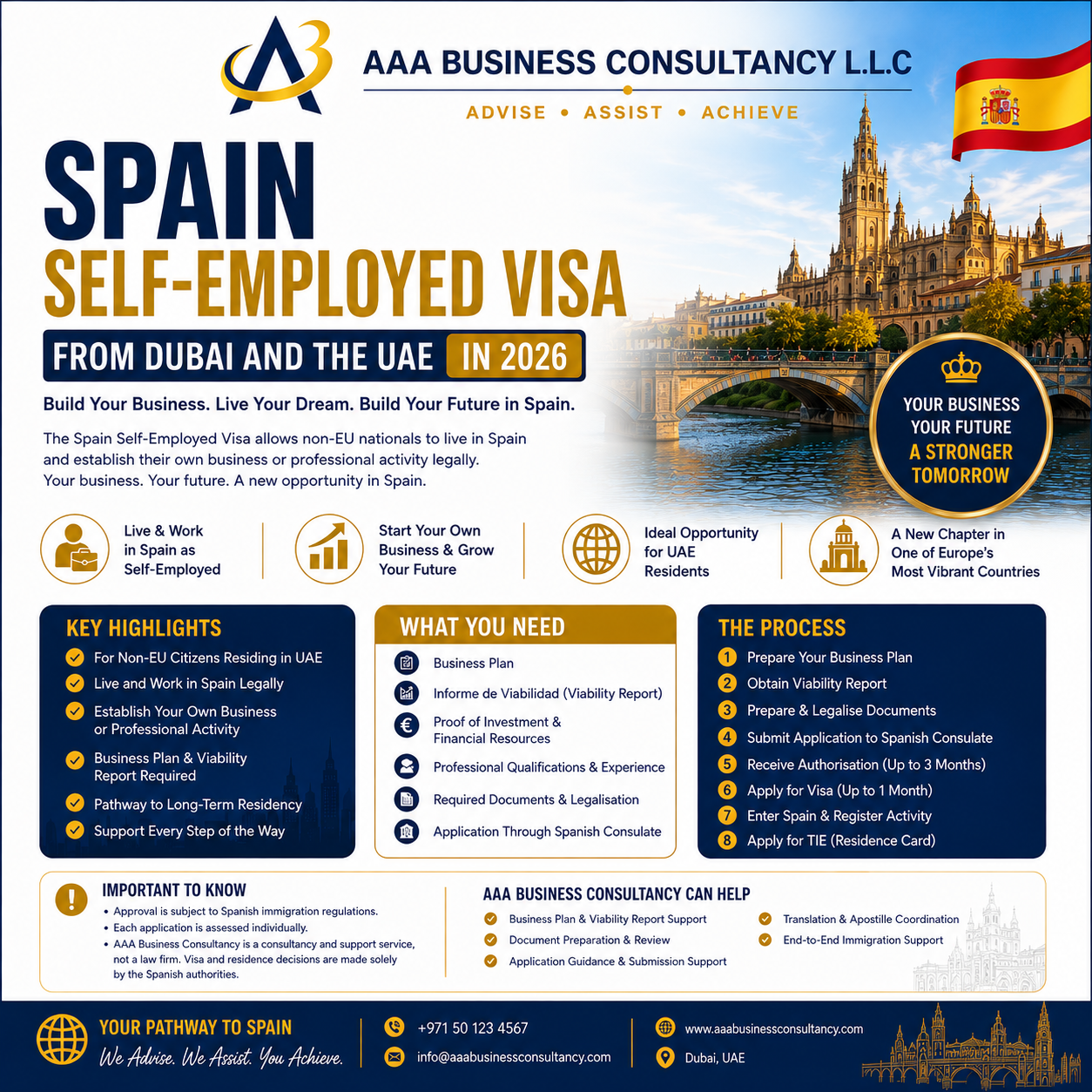
Start and Operate Your Own Business in Spain
Spain offers an immigration pathway for non-EU nationals who want to establish and operate their own business or professional activity in the country.
Known officially as the initial temporary residence and self-employed work authorisation, this route may be suitable for entrepreneurs, independent professionals, consultants, tradespeople and other applicants who intend to earn income through their own activity in Spain.
Unlike an employee work visa, the applicant does not depend on a Spanish employer offering an employment contract. Instead, the applicant must present a credible business project and demonstrate that they have the qualifications, experience, investment and operational arrangements required to carry out the proposed activity.
The authorisation is intended for foreign nationals who are not already resident in Spain and who wish to perform a profitable self-employed activity in the country. (Inclusión y Seguridad Social)
What Is the Spain Self-Employed Visa?
The Spain Self-Employed Visa allows an eligible non-EU national to live in Spain and carry out an approved activity on a self-employed basis.
In Spain, a self-employed person is commonly referred to as an autónomo. Depending on the business structure and activity, the applicant may operate as an individual professional, establish a company or use another legally appropriate structure.
The immigration application is based on a specific proposed activity. The applicant must explain:
- What business or professional service will be provided
- Where the activity will operate
- Who the intended customers are
- How the business will generate income
- What investment is required
- Whether licences or professional registrations are needed
- Why the applicant is qualified to operate the business
- Whether the project may create employment, including self-employment
Spain’s immigration authority requires applicants to demonstrate that the proposed investment is sufficient and that the applicant has the necessary qualifications or documented professional experience for the activity. (Inclusión y Seguridad Social)
Who Can Apply from Dubai or the UAE?
This immigration route may be considered by UAE residents who are nationals of countries outside the European Union, European Economic Area and Switzerland.
Applicants generally need to demonstrate that they:
- Are legally resident in the UAE
- Are not in Spain irregularly
- Do not have relevant criminal convictions
- Are not subject to an entry prohibition
- Meet the legal requirements for establishing the proposed activity
- Have sufficient professional qualifications or relevant experience
- Have access to sufficient funds for the planned investment
- Can obtain the licences, registrations or approvals required for the activity
- Can pay the applicable government application fees
The applicant must normally submit the application personally through the Spanish consular office responsible for their place of legal residence. (Inclusión y Seguridad Social)
Eligibility must be assessed individually. Owning an existing company in Dubai or having business experience in the UAE can strengthen an application, but it does not automatically guarantee approval.
What Types of Businesses May Be Considered?
The Self-Employed Visa is not limited to one industry. Applicants may propose different lawful commercial or professional activities, subject to local licensing and regulatory requirements.
Examples may include:
- Business consultancy
- Marketing and advertising services
- Information technology services
- Software development
- Design and creative services
- Restaurants, cafés and food businesses
- Retail businesses
- Cleaning or maintenance services
- Beauty and wellness businesses
- Tourism-related services
- Import and export activities
- Property-related services
- Training and educational services
- Independent professional consultancy
- Skilled trades and technical services
The applicant should not select an activity only because it appears easy to register. The business concept should be realistic, commercially viable and connected to the applicant’s qualifications, professional background or demonstrated experience.
Some activities are regulated in Spain and may require recognition of qualifications, professional association membership or sector-specific approval before the applicant can operate legally.
Is There a Minimum Investment Amount?
There is no single fixed investment amount that applies to every Self-Employed Visa application.
The required investment depends on the type, scale and location of the proposed business. A consultancy operated from a small office may require less capital than a restaurant, retail shop, workshop or activity involving specialised equipment.
The applicant must demonstrate that the proposed investment is sufficient to establish and operate the particular project. The authorities may also consider the project’s effect on employment, including the applicant’s own self-employment. (Inclusión y Seguridad Social)
The financial section should clearly explain expected costs such as:
- Company formation or self-employment registration
- Commercial premises or coworking space
- Rental deposits
- Equipment and technology
- Professional licences
- Insurance
- Marketing and advertising
- Initial stock or inventory
- Employee costs
- Professional service fees
- Working capital
- Personal living expenses during the start-up period
Merely showing money in a bank account may not be enough. The financial evidence should correspond with the investment and operating costs presented in the business plan.
Why Is the Business Plan Important?
The business plan is one of the most important elements of the application.
It should show that the applicant has properly researched the Spanish market and has a realistic strategy for establishing and maintaining the proposed activity.
A professional business plan should normally address:
Executive Summary
A concise overview of the project, its objectives, services, location, investment and expected commercial results.
Applicant’s Professional Profile
Information about the applicant’s education, qualifications, employment history, business ownership, technical abilities and relevant industry experience.
Description of the Activity
A detailed explanation of the products or services that will be provided and how the activity will operate in Spain.
Market Analysis
Research concerning the target market, customer profile, demand, location, industry conditions and expected growth opportunities.
Competitor Analysis
Identification of direct and indirect competitors and an explanation of how the proposed business will differentiate itself.
Marketing and Sales Strategy
Details about pricing, promotion, customer acquisition, partnerships, digital marketing and sales channels.
Operational Plan
Information about premises, suppliers, equipment, staffing, licences, technology and daily business operations.
Investment Plan
A breakdown of the funds required to launch the activity and evidence showing how the investment will be financed.
Financial Forecast
Projected sales, expenses, cash flow and profitability. The calculations should be reasonable and supported by the assumptions presented in the plan.
Employment Impact
An explanation of whether the business will create jobs. The applicant’s own self-employment may also be considered when assessing the project’s employment impact. (Inclusión y Seguridad Social)
An incomplete business plan, unrealistic revenue projections or unsupported financial assumptions may weaken the application.
What Is an Informe de Viabilidad?
An informe de viabilidad, or project valuation report, is an independent assessment of the proposed business and its feasibility.
Spain’s Ministry of Inclusion identifies several recognised organisations whose valuation reports may be used to support evidence concerning professional capability, the sufficiency of the proposed investment and potential employment creation. These organisations include ATA, UPTA, CIAE, OPA and UATAE. (Inclusión y Seguridad Social)
The report may examine:
- The applicant’s professional profile
- The proposed business activity
- Market conditions
- Required investment
- Financial forecasts
- Licences and regulatory requirements
- Operational arrangements
- Employment creation
- Overall feasibility of the project
UPTA states that it is authorised to issue valuation reports for applicants seeking temporary residence and self-employed work authorisation. It also provides guidance concerning business plans, legal business structures, investment and procedures for launching an activity. (UPTA)
The business plan and the viability report serve related but different purposes. The business plan describes and supports the proposed project, while the valuation report provides an external assessment by an eligible organisation.
Applicants should confirm the precise requirements applicable to their proposed business, consular jurisdiction and individual case before proceeding.
Documents Commonly Required
The exact checklist depends on the applicant’s nationality, UAE residence status, activity and consular requirements.
Documents commonly associated with the authorisation stage include:
- Completed EX-07 application form
- Complete copy of the applicant’s valid passport
- UAE residence evidence
- Criminal-record certificates from the relevant countries
- Business plan
- Evidence of sufficient investment
- Bank statements or other financial evidence
- Proof of professional qualifications
- Employment and experience certificates
- Company ownership or business documents
- Information about the proposed business location
- Required licences, permits or evidence that they have been requested
- Professional registration or qualification recognition, when applicable
- Project valuation or viability report
- Proof of payment of the relevant government fees
The Ministry specifically lists the EX-07 form, passport copy, criminal-record evidence, professional qualifications, licences and proof of sufficient investment among the required documentation. (Inclusión y Seguridad Social)
Following approval of the residence and work authorisation, the visa stage may also require a passport with the necessary validity, criminal-record documentation and a medical certificate. (Inclusión y Seguridad Social)
Sworn Translation, Apostille and Legalisation
Documents issued outside Spain may need to be translated into Spanish.
Where an official Spanish translation is required, the document may need to be translated by a sworn translator recognised by the Spanish authorities.
Foreign public documents may also require an apostille or diplomatic legalisation, depending on:
- The country that issued the document
- Whether the issuing country participates in the Hague Apostille Convention
- The type of document
- Whether an international agreement provides an exemption
Spain’s immigration authority states that foreign documents must generally be translated into Spanish or the relevant co-official language. Foreign public documents must also be legalised or apostilled unless an applicable exemption exists. (Inclusión y Seguridad Social)
Translations and legalisations should be planned early because criminal-record certificates and other documents may have limited validity.
Application Process from the UAE
Step 1: Complete a Professional Case Assessment
The applicant’s nationality, UAE residence, professional background, proposed activity, financial capacity and immigration history should be reviewed before preparing the application.
This helps determine whether the Self-Employed Visa is the appropriate route or whether another Spanish visa or residence category may be more suitable.
Step 2: Define the Business Activity
The proposed activity, location, legal structure, market, investment and licensing requirements should be identified.
Step 3: Prepare the Business Plan
The business plan should present the project professionally and include commercially supportable financial forecasts.
Step 4: Arrange the Viability Evaluation
Where applicable, the plan and supporting documents may be submitted to an authorised organisation for a project valuation report.
Step 5: Prepare Supporting Documents
Personal, professional, financial and business documents should be collected and checked for consistency.
Step 6: Complete Translation and Legalisation
Documents requiring sworn translation, apostille or consular legalisation should be processed in the correct order.
Step 7: Submit the Authorisation Application
The applicant normally submits the application personally through the Spanish consular office corresponding to their place of residence.
The applicable residence and work fees include Form 790 Code 052 and, where applicable, Form 790 Code 062. The official guidance states that these fees are payable within 10 working days of the application being submitted. (Inclusión y Seguridad Social)
Step 8: Await the Authorisation Decision
The official resolution period for the initial residence and self-employed work authorisation is up to three months from the day after the application enters the competent authority’s register. Actual timelines may vary depending on the case and requests for additional information. (Inclusión y Seguridad Social)
Step 9: Complete the Visa Stage
After a favourable authorisation decision, the applicant has one month from notification to request the visa personally through the competent Spanish diplomatic mission or consular office.
The official guidance indicates that the consular visa decision should then be made within one month. (Inclusión y Seguridad Social)
Step 10: Enter Spain and Register the Activity
The visa is generally valid for entry during a three-month period. After entering Spain, the applicant must complete the applicable Social Security registration and begin complying with the obligations connected to the approved activity. (Inclusión y Seguridad Social)
Step 11: Apply for the TIE
After the relevant Social Security registration, the applicant must personally request the Tarjeta de Identidad de Extranjero, commonly known as the TIE.
The official procedure provides a period of one month following Social Security registration to request the TIE from the appropriate police station. (Inclusión y Seguridad Social)
How Long Is the Initial Authorisation Valid?
The initial temporary residence and self-employed work authorisation is valid for one year.
The initial authorisation is limited to a particular autonomous-community territory and a specific business sector. The applicant should therefore ensure that the planned location and activity are correctly identified in the application. (Inclusión y Seguridad Social)
Renewal will depend on meeting the applicable immigration conditions and demonstrating proper continuation of the activity.
Self-Employed Visa vs Entrepreneur Visa
The Self-Employed Visa and Entrepreneur Visa are not the same immigration category.
Self-Employed Visa
This route may be used for a broad range of viable commercial and professional activities. The applicant must demonstrate sufficient investment, relevant experience or qualifications and compliance with the requirements for opening and operating the activity.
Entrepreneur Visa
The Entrepreneur Visa is intended for an innovative entrepreneurial activity considered to be of particular economic interest to Spain. (Ministry of Foreign Affairs)
A conventional consultancy, shop, restaurant or service business may be more appropriate for the Self-Employed Visa unless it has the innovation and economic-interest characteristics required for the Entrepreneur Visa.
Choosing the wrong category can result in unnecessary expense, delays or an application that does not match the applicant’s actual project.
Common Application Mistakes
Applicants should take care to avoid the following issues:
- Presenting a generic or copied business plan
- Using unrealistic revenue forecasts
- Failing to explain the source of investment funds
- Selecting an activity unrelated to the applicant’s experience
- Ignoring municipal or professional licensing requirements
- Providing inconsistent financial figures
- Submitting expired criminal-record documents
- Failing to legalise or apostille foreign documents
- Using translations that do not meet Spanish requirements
- Confusing the Self-Employed Visa with the Digital Nomad or Entrepreneur Visa
- Assuming that company registration alone guarantees immigration approval
- Making non-refundable business commitments before the immigration position is properly assessed
A well-prepared application should tell one clear and consistent story across the business plan, financial records, professional documents and supporting declarations.
Can Family Members Accompany the Applicant?
The possibility and timing of including family members should be assessed according to the immigration rules applicable to the main applicant and dependants.
Applicants planning to move with a spouse, partner or children should consider the family’s:
- Passport validity
- Civil-status documents
- Financial requirements
- Medical insurance
- Accommodation
- Translation and legalisation requirements
- Schooling arrangements
- Post-arrival registration
Family planning should form part of the immigration strategy from the beginning rather than being considered only after the principal applicant’s file has been prepared.
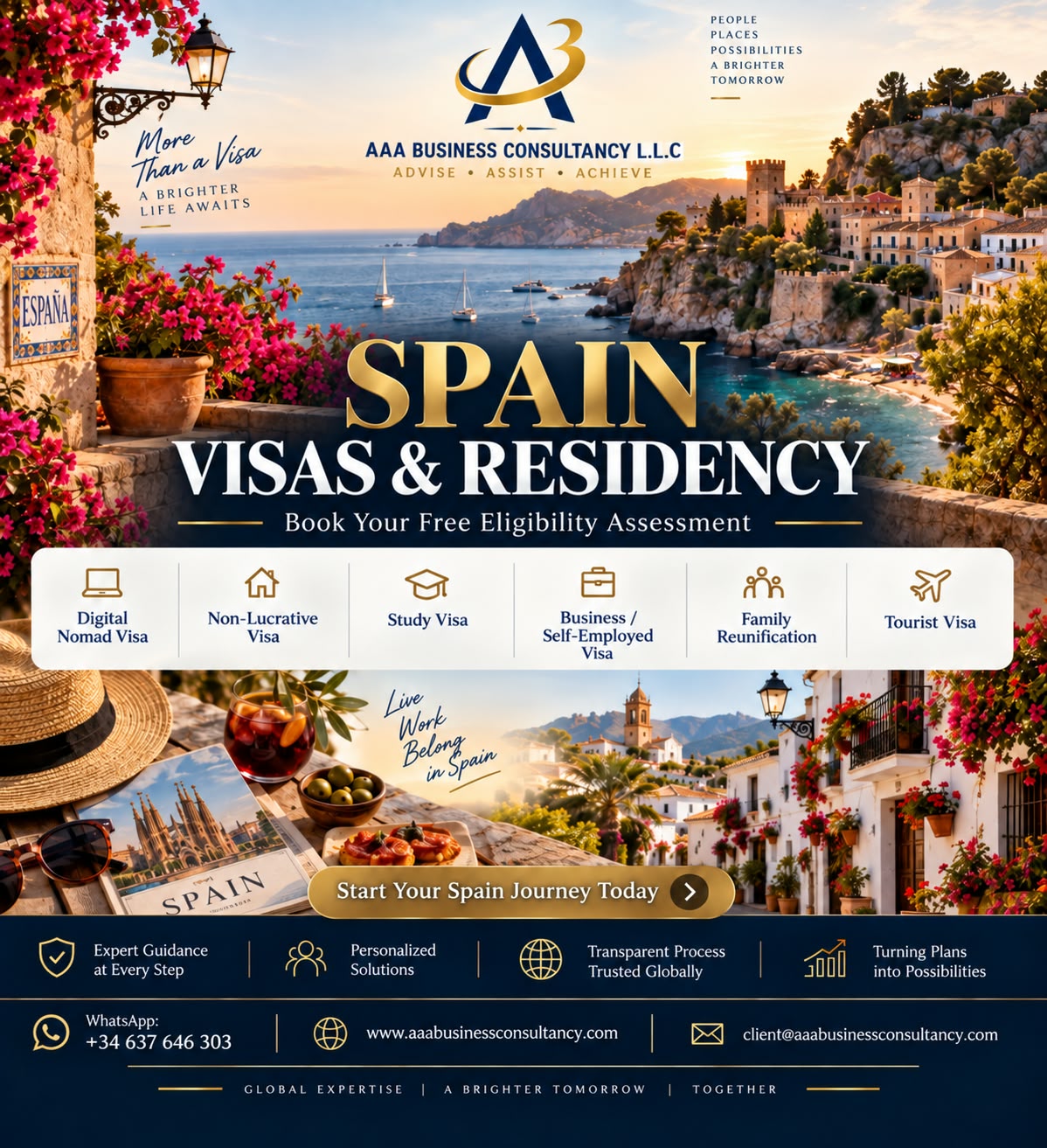
How AAA Business Consultancy Can Assist
AAA Business Consultancy L.L.C. is a Dubai-based consultancy specialising in Spain visa, residency, immigration and relocation support.
Depending on the selected service package and the applicant’s circumstances, our professional assistance may include:
- Professional case assessment
- Eligibility and immigration-route review
- Personalised document checklist
- Business-plan preparation coordination
- Viability-report coordination
- Review of professional and financial evidence
- Application-form preparation assistance
- Document review and organisation
- Sworn-translation coordination
- Apostille and legalisation coordination
- Application-process guidance
- Appointment coordination
- Post-arrival administrative assistance
- NIE, TIE and other relocation support, where included
AAA Business Consultancy provides consultancy, guidance, coordination and administrative support. Visa, residence and work-authorisation decisions are made solely by the competent Spanish authorities, and approval cannot be guaranteed. (AAABusinessConsultancy)
Begin with a Professional Assessment
A Self-Employed Visa application requires more than a business idea. The project must be supported by a credible plan, sufficient investment, appropriate experience, properly prepared documents and a clear immigration strategy.
Before investing in premises, equipment, company formation or other major expenses, applicants should first determine whether their proposed activity and professional background are suitable for this route.
Book your Free Eligibility Assessment with AAA Business Consultancy and take the first step toward establishing your business in Spain.
AAA Business Consultancy L.L.C.
Advise • Assist • Achieve
This article is provided for general informational purposes and does not constitute legal advice. Immigration requirements, consular procedures, government fees and document checklists may change. Each application is assessed individually by the competent Spanish authorities.