Spain continues to attract people from around the world who are looking for a better quality of life, a European lifestyle, excellent healthcare, beautiful cities, and a safe environment for their families.
But what if you want to live in Spain without taking up employment there?
This is where the Spain Non-Lucrative Visa may be worth considering.
The Non-Lucrative Visa is a residence option for eligible non-EU nationals who can demonstrate sufficient financial means to support themselves in Spain without carrying out employment or professional activities in the country.
For individuals considering Spain immigration, understanding how this visa works, who it is suitable for, what financial requirements apply, and what documents are needed is an important part of making an informed decision.
What Is the Spain Non-Lucrative Visa?
The Spain Non-Lucrative Visa, also referred to as the Non-Lucrative Residence Visa, is designed for non-EU/EEA/Swiss nationals who want to reside in Spain without working in Spain.
The basic concept is relatively straightforward:
You must be able to support yourself financially without relying on employment or professional activity in Spain.
This can make the route particularly interesting for people with sufficient savings, pensions, investments, or other qualifying financial resources.
However, having money available is not the only consideration. Applicants must also satisfy the relevant legal, health, documentation, and residence requirements.
Why Are People Choosing Spain?
Spain offers much more than a popular holiday destination.
For many applicants, moving to Spain is about creating a long-term lifestyle.
Some of the reasons people consider Spain include:
- High quality of life
- Mediterranean climate
- European lifestyle
- Excellent food and culture
- Well-developed healthcare system
- International communities
- Good transport connections
- Family-friendly cities
- Access to Spain’s education system
- Opportunity to establish long-term residence in Europe
For financially independent individuals, the Non-Lucrative Visa can provide a pathway to live in Spain while focusing on their personal and family life rather than employment.
Who Is the Spain Non-Lucrative Visa For?
The Non-Lucrative Visa may be suitable for individuals who have sufficient financial resources and do not need to work in Spain.
Potential applicants may include:
Retirees
Retirees who receive a regular pension or have sufficient financial resources may consider this residence option if they meet the applicable requirements.
Financially Independent Individuals
Applicants with substantial savings or qualifying passive income may also explore this route.
Families
Families who want to relocate to Spain and have sufficient financial means may be able to apply with eligible family members, subject to the applicable requirements.
Individuals Planning a Lifestyle Move
Some applicants simply want to spend an extended period living in Spain without taking up employment.
However, every applicant’s circumstances are different.
A person who wants to work remotely for a company outside Spain, for example, should carefully consider whether another immigration route would be more appropriate.
Can You Work in Spain With a Non-Lucrative Visa?
This is one of the most important questions applicants ask.
The Non-Lucrative Visa is intended for people who do not carry out employment or professional activities in Spain.
Therefore, it should not simply be viewed as a general work visa.
If your intention is to:
- Work remotely
- Provide professional services
- Operate a business
- Become self-employed
- Work for a Spanish company
you may need to consider a different residence or immigration route.
For example, individuals who work remotely for companies or clients outside Spain may need to examine whether the Spain Digital Nomad Visa is more appropriate for their circumstances.
Choosing the correct visa before starting the application process is extremely important.
What Are the Financial Requirements?
Financial means are one of the central parts of a Non-Lucrative Visa application.
The applicant needs to demonstrate that they have sufficient financial resources to support themselves during their stay in Spain without working.
The required amount is linked to Spain’s applicable financial threshold and can change over time.
Applicants should therefore avoid relying on old information found online.
The financial evidence may include appropriate documentation demonstrating:
- Savings
- Pension income
- Investment income
- Other qualifying financial resources
- Regular income where applicable
The authorities will also consider the applicant’s family circumstances.
What If You Are Applying With Your Family?
If you are applying with a spouse or dependent children, the required financial resources generally increase because you need to demonstrate the ability to support the additional family members.
This is why calculating the financial requirement based on the entire family profile is important before preparing the application.
What Counts as Proof of Financial Means?
Financial documentation needs to clearly demonstrate that the applicant has sufficient resources.
Depending on the individual circumstances, supporting evidence may include appropriate:
- Bank statements
- Pension statements
- Investment documentation
- Income documentation
- Financial certificates
- Other evidence demonstrating available resources
The quality and consistency of the evidence matter.
For example, simply showing a large amount of money in an account shortly before an application may not always provide the complete financial picture an applicant needs.
A properly prepared application should explain and document the source and availability of the financial resources being relied upon.
Can Your Family Join You in Spain?
For many applicants, one of the biggest advantages of exploring Spanish residence is the possibility of relocating with their family.
Eligible family members may be able to accompany or join the main applicant, depending on the applicable rules and their circumstances.
This can potentially include:
- Spouse
- Qualifying partner
- Dependent children
- Other eligible family members in specific circumstances
Family applications require additional documentation.
The applicant may also need to demonstrate additional financial resources to support each accompanying family member.
Therefore, families should not assess the Non-Lucrative Visa based only on the main applicant’s eligibility.
The entire family profile should be reviewed.
What Documents Are Needed?
A Non-Lucrative Visa application normally requires extensive supporting documentation.
The exact requirements can depend on the applicant’s nationality, country of legal residence, family situation, and the relevant Spanish authority handling the application.
Common documents may include:
1. Passport
A valid passport meeting the applicable validity and blank-page requirements.
2. Visa Application Forms
The relevant application forms must be completed accurately and consistently.
3. Proof of Financial Means
Applicants need to provide evidence demonstrating sufficient financial resources.
4. Health Insurance
Appropriate health insurance coverage meeting the applicable requirements is generally required.
5. Criminal Record Certificate
Applicants may need to provide criminal record certificates covering the relevant countries of residence.
6. Medical Certificate
A medical certificate may be required to confirm compliance with the applicable health requirements.
7. Proof of Residence
Applicants applying from outside their country of nationality may need to demonstrate their legal residence in the country where they submit the application.
8. Civil Documents
Depending on the family situation, documents such as:
- Marriage certificates
- Birth certificates
- Proof of dependency
- Other family relationship documents
may be required.
9. Legalization and Translation
Foreign documents may need to be legalized or apostilled and translated into Spanish by an authorized sworn translator, where required.
Applying for a Spain Non-Lucrative Visa From the UAE
For applicants legally residing in the UAE, the application process involves preparing the required documentation and submitting the application through the appropriate Spanish consular or visa authority responsible for their place of residence.
Preparation is extremely important.
Applicants should carefully check:
- Which documents are required
- Which documents require legalization
- Which documents require apostille
- Which documents require Spanish translation
- How recent each document must be
- How financial resources should be demonstrated
- Whether additional documents are required for family members
A missing or incorrectly prepared document can result in delays or complications.
How Long Can You Stay in Spain?
The Non-Lucrative Visa is a residence route, rather than simply a short-term visit visa.
After obtaining the relevant residence authorization, applicants must comply with the applicable conditions of their residence.
This also means that people considering the visa should think beyond the initial application.
Before applying, it is useful to consider:
Where will you live in Spain?
How will you demonstrate your financial resources?
Will your family accompany you?
How long do you intend to remain in Spain?
What are your long-term residence plans?
Having clear answers to these questions can make the planning process much easier.
Can You Travel Around the Schengen Area?
Spain is part of the Schengen Area.
Once you have the appropriate Spanish residence documentation, you may have certain travel rights within the Schengen Area, subject to the applicable rules and conditions.
However, residence in Spain and travelling around Europe are not the same thing.
Applicants should understand the distinction between:
- Spanish residence rights
- Schengen short-stay travel rules
- Residence requirements
- Tax residency considerations
This is particularly important for people who intend to spend significant periods travelling between different European countries.
What About Tax Residency?
Obtaining a Spanish residence visa and becoming a Spanish tax resident are related but not necessarily the same question.
Your tax position can depend on factors such as:
- How many days you spend in Spain
- Where your main economic interests are located
- Your family circumstances
- Income and assets
- Applicable tax rules
- Any relevant tax treaty
For this reason, applicants with substantial income, investments, businesses, or international assets should consider obtaining appropriate tax advice before relocating.
Immigration planning and tax planning should be considered separately.
Common Mistakes Applicants Should Avoid
A strong application is not simply about collecting documents.
Applicants should also make sure that the information presented throughout the application is consistent.
Some common issues include:
❌ Relying on outdated financial figures
Financial requirements can change, so applicants should verify the current threshold.
❌ Providing unclear bank statements
Financial evidence should clearly demonstrate the availability and legitimacy of the resources being relied upon.
❌ Choosing the wrong visa
If you intend to work remotely or operate a business, the Non-Lucrative Visa may not necessarily be the appropriate route.
❌ Ignoring family requirements
Adding family members can change the financial and documentary requirements.
❌ Submitting incomplete documents
Missing legalization, apostille, translation, or supporting evidence can create unnecessary problems.
❌ Treating every applicant’s case as identical
Two applicants applying for the same visa can have very different circumstances.
Non-Lucrative Visa vs Digital Nomad Visa
One of the most common questions is:
“Which visa should I choose?”
The answer depends on what you intend to do while living in Spain.
| Non-Lucrative Visa | Digital Nomad Visa |
|---|---|
| Designed for residence without employment/professional activity in Spain | Designed for eligible remote work |
| Financial means are a key requirement | Employment/business eligibility is important |
| Suitable for financially independent applicants | Suitable for qualifying remote workers |
| Work restrictions are important | Remote professional activity is central |
| Family options may be available | Family options may be available |
This comparison highlights why choosing the right immigration route is so important.
Is Spain’s Non-Lucrative Visa a Path to Permanent Residence?
For people considering Spain as a long-term home, the initial residence permit may be only the beginning.
Depending on the applicant’s circumstances and continued compliance with Spanish residence requirements, there may be opportunities to progress toward longer-term residence.
However, applicants should not assume that receiving the first residence authorization automatically guarantees permanent residence or citizenship.
Long-term immigration planning should consider:
- Continuous legal residence
- Renewal requirements
- Time physically spent in Spain
- Financial circumstances
- Family circumstances
- Eligibility for future residence options
- Applicable nationality requirements
Professional advice can be particularly useful for applicants who are planning several years ahead.
Why Professional Preparation Matters
Spain immigration applications can involve a significant amount of documentation.
A successful strategy begins with understanding the applicant’s circumstances before deciding which route to pursue.
For example, an applicant may initially think the Non-Lucrative Visa is suitable, but after reviewing their situation, another option could potentially be more appropriate.
A professional assessment can help identify:
- The most suitable visa route
- Financial eligibility
- Family eligibility
- Documentation requirements
- Potential weaknesses in the application
- Translation and legalization requirements
- Possible next steps
Is the Spain Non-Lucrative Visa Right for You?
The Non-Lucrative Visa can be an attractive option for people who want to establish residence in Spain and have sufficient financial resources without relying on employment in Spain.
However, it is not a one-size-fits-all solution.
Your:
- Nationality
- Country of residence
- Income
- Savings
- Employment status
- Family circumstances
- Intended activities in Spain
- Long-term plans
can all influence which immigration pathway may be most suitable.
Before making a decision, it is important to assess your personal circumstances rather than relying solely on someone else’s experience.
Start Planning Your Move to Spain
If you are considering relocating to Spain, understanding the available residence options is the first step.
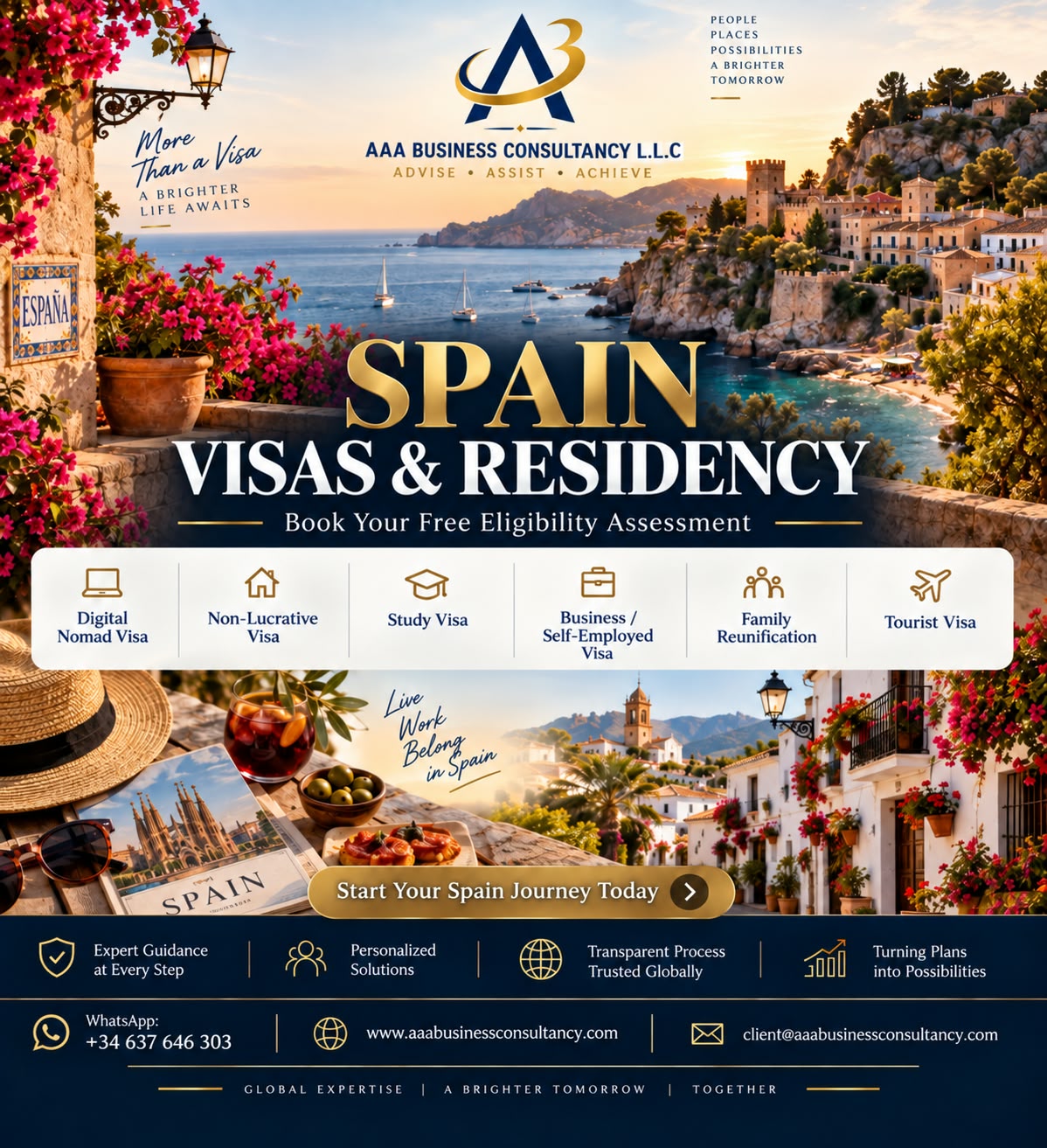
At AAA Business Consultancy L.L.C, we provide Spain Visa & Residency Services to clients exploring different Spanish visa and residence pathways.
Our team can help you understand the requirements, review your circumstances, identify the appropriate route, and guide you through the documentation and application process.
If you are considering the Spain Non-Lucrative Visa, don’t make your decision based on general information alone.
Your circumstances matter. Your family situation matters. Your financial profile matters. And choosing the right immigration pathway matters.
🇪🇸 Thinking About Living in Spain?
Book a Professional Case Assessment with AAA Business Consultancy L.L.C and take the next step toward understanding your Spain residence options.
AAA Business Consultancy L.L.C
Spain Visa & Residency Services
Advise • Assist • Achieve