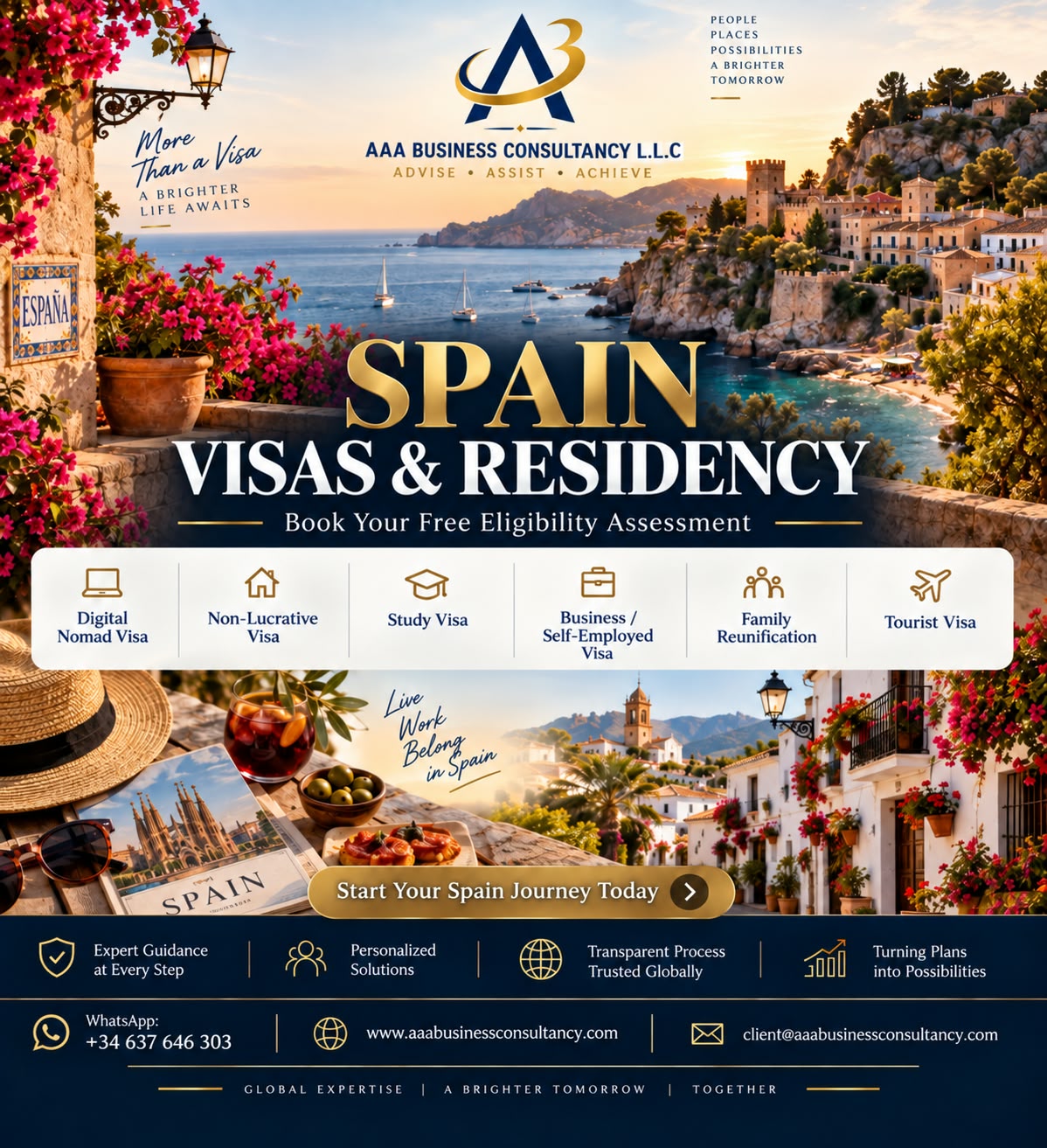
Thinking about moving from Dubai to Spain?
For many UAE residents, Spain offers an attractive combination of European lifestyle, education, business opportunities, healthcare, culture and long-term residency possibilities. However, moving from the UAE to Spain is not simply a matter of booking a flight and applying for a visa.
The most important first step is choosing the correct Spain visa and immigration pathway for your personal circumstances.
Whether you are a remote worker, entrepreneur, student, retiree, professional or family member, Spain has different immigration routes designed for different purposes.
In this guide, we explain the main options available to people considering a move from Dubai to Spain in 2026 — without focusing on financial requirements.
Spain Visa or Spain Residency: What Is the Difference?
One of the first things applicants should understand is the difference between a visa and a residence authorization.
A visa is generally the document that allows a person to enter Spain for the purpose for which it has been granted. Depending on the category and circumstances, the applicant may then complete additional residence formalities in Spain.
For long-term relocation, applicants normally need a national visa or the appropriate residence authorization, rather than a short-stay Schengen tourist visa.
Spain’s national visa system covers different purposes including residence, employment and study for stays exceeding 90 days. (Ministry of Foreign Affairs)
This distinction is important because choosing a tourist visa when your real objective is to establish residence in Spain may not be the appropriate immigration strategy.
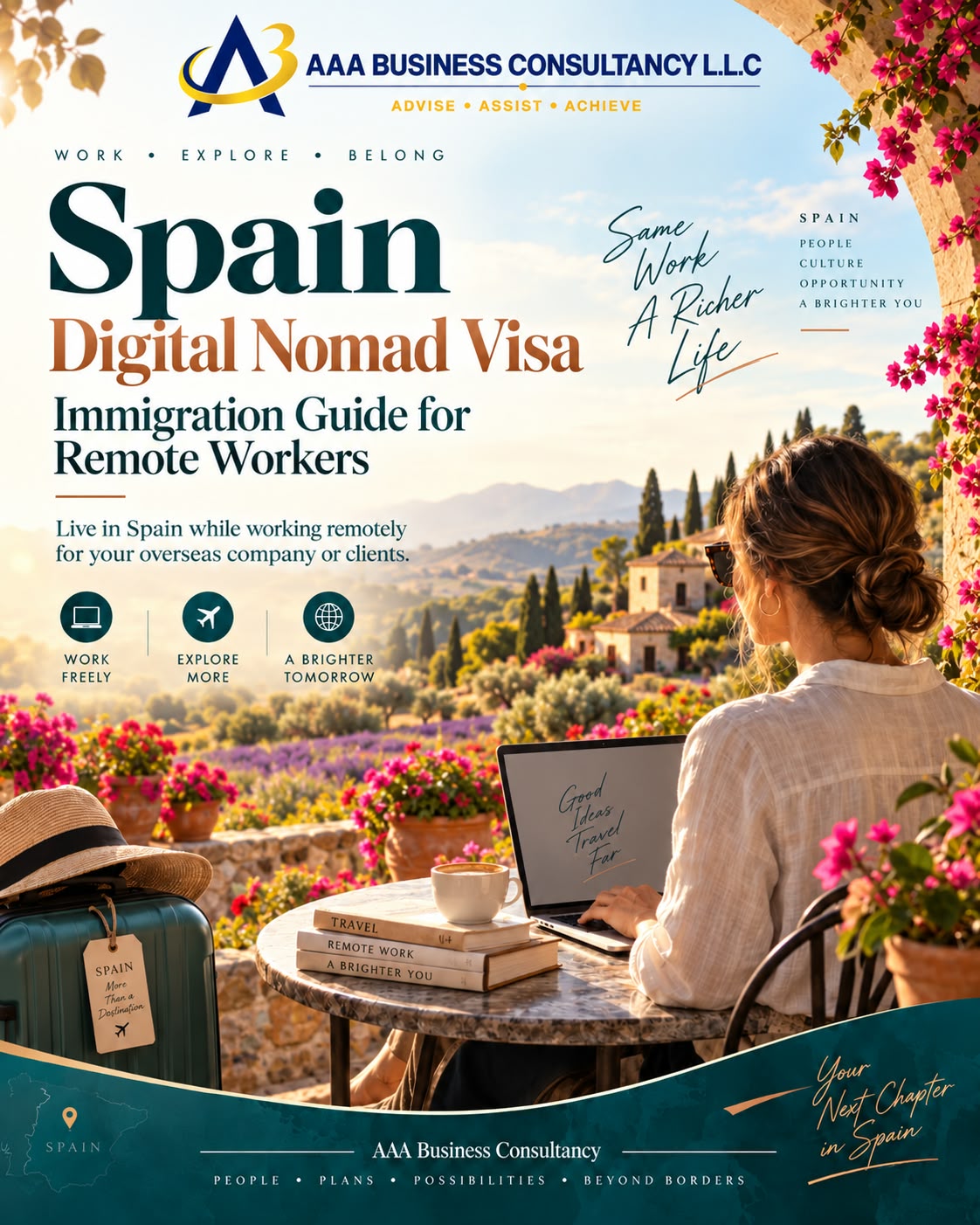
1. Spain Digital Nomad Visa
If you currently live in Dubai and work remotely, the Spain Digital Nomad Visa could be one of the most relevant options to consider.
The visa is designed for non-EU nationals who want to live in Spain while carrying out remote employment or professional activities using computer and telecommunications systems.
For an employee, the employment relationship is generally with a company located outside Spain.
For a self-employed professional, work for Spanish companies can be permitted within the limits established by the applicable rules. The Spanish Embassy in Abu Dhabi currently states that such activity cannot exceed 20% of the professional activity. (Ministry of Foreign Affairs)
Who could consider this option?
It may be relevant for:
- Remote employees
- Freelancers
- Consultants
- Technology professionals
- Online professionals
- Business owners working remotely
- Other qualifying professionals whose work can be performed remotely
Applicants must also satisfy professional eligibility requirements. These can include an appropriate university or postgraduate qualification, recognized professional training, or the required professional experience. (Ministry of Foreign Affairs)
Can your family accompany you?
Yes. Eligible family members can also obtain residence under the Digital Nomad framework, subject to the applicable requirements and supporting documentation. (Ministry of Foreign Affairs)
Important point
The Digital Nomad Visa is not simply a visa for anyone who works online.
The applicant needs to demonstrate that the employment or professional relationship, qualifications or experience, company activity and remote-working arrangement satisfy the applicable requirements.
2. Spain Non-Lucrative Visa
If your objective is to live in Spain without working or carrying out professional activities there, the Non-Lucrative Visa may be an option.
The Spanish Embassy describes this as a visa for people who want to reside in Spain without carrying out gainful employment or professional activity. It is therefore fundamentally different from the Digital Nomad Visa. (Ministry of Foreign Affairs)
Who is this route generally designed for?
It can be relevant to:
- Retirees
- Financially independent individuals
- People who want to relocate without working
- Families seeking a residence option where the applicant does not intend to work in Spain
The applicant must meet the applicable residence, documentation, health and other requirements.
Can family members join?
The Spanish Embassy in Abu Dhabi states that eligible family members can include:
- A spouse or unmarried partner
- Dependent children
- Dependent relatives in the ascending line who form part of the family unit (Ministry of Foreign Affairs)
A crucial distinction
If you intend to continue working remotely after moving to Spain, you should not automatically assume that the Non-Lucrative Visa is appropriate.
Spain’s immigration authorities specifically distinguish non-working residence from remote-working residence. (Inclusión y Migraciones)
3. Spain Business and Self-Employed Residency
Are you an entrepreneur or business owner in Dubai who wants to establish a professional activity in Spain?
A self-employed residence and work authorization may be worth considering.
Spain provides an authorization for foreign nationals who are not residents in Spain and intend to carry out a lucrative activity on a self-employed basis. (Inclusión y Migraciones)
The application can involve evaluating the proposed business or professional activity, including aspects such as:
- The nature of the business
- Professional qualifications
- The viability of the proposed activity
- The planned investment
- Potential employment creation
- Relevant licenses or authorizations
- Criminal-record documentation
- Supporting business documentation
The official Spanish immigration guidance specifically refers to demonstrating that the planned investment is sufficient and considering the impact on job creation where applicable. (Inclusión y Migraciones)
Who could consider this route?
This may be relevant to:
- Entrepreneurs
- Business owners
- Consultants
- Freelancers
- Professionals establishing a business
- Individuals planning to operate a business in Spain
However, the exact route depends on the nature of the planned activity and the applicant’s circumstances.
4. Spain Study Visa
Spain is also a popular destination for international students.
If you have been accepted by an eligible Spanish educational institution, a study visa or study-related residence authorization may be the appropriate pathway.
This can be relevant to students planning to undertake qualifying:
- Bachelor’s degrees
- Master’s degrees
- Higher education programmes
- Professional training
- Research activities
- Other eligible educational programmes
The study route is different from a standard employment or residence visa, and applicants need to demonstrate that they have been admitted to an eligible programme and satisfy the applicable requirements.
Why choose Spain for studies?
For UAE-based students, Spain can offer:
- European higher education
- Internationally recognized qualifications
- Spanish-language learning opportunities
- A multicultural environment
- Access to a wide range of public and private educational institutions
- Opportunities to experience life in Europe
Students should carefully check the eligibility of their chosen course and institution before beginning the visa process.
5. Family Reunification and Family-Based Residence
Moving to Spain does not always mean that every family member needs to apply independently for the same visa.
Depending on the circumstances, family members may have immigration options connected to the residence status or nationality of a family member in Spain.
Spain has specific procedures for family reunification, and the applicable requirements can depend on the status of the person already residing in Spain.
For example, the official immigration guidance for family reunification addresses documentation concerning family relationships, financial support and suitable accommodation. (Inclusión y Migraciones)
There are also separate provisions for certain family members of Spanish nationals, with the applicable rules updated under Spain’s current immigration framework. (Inclusión y Migraciones)
Why is this important?
A family immigration case should be assessed based on:
- The relationship between family members
- The nationality of the family member in Spain
- The residence status of the sponsor
- Whether the family member is dependent
- The age of children
- Existing residence arrangements
- The applicable Spanish immigration procedure
This is why simply choosing a visa based on another person’s application may not always be appropriate.
6. Spain Tourist Visa
If your purpose is simply to visit Spain for a holiday, business meeting, tourism or another short-term purpose, the Schengen short-stay visa may be relevant depending on your nationality and circumstances.
However, a tourist visa should not be confused with a residence visa.
Tourist visa vs residence visa
A tourist visa is designed for short stays.
A residence route is intended for people who want to establish a longer-term legal stay in Spain.
If your actual objective is to relocate from Dubai to Spain, you should assess the appropriate long-term immigration pathway rather than treating a tourist visa as a substitute for residence.
How Do You Choose the Right Spain Visa?
The best starting point is to ask yourself why you want to move to Spain.
Are you working remotely?
Consider whether the Digital Nomad Visa fits your employment or professional situation.
Do you want to live in Spain without working?
The Non-Lucrative Visa may be worth exploring.
Do you want to start or operate a business?
Look into the applicable self-employed or business immigration route.
Do you want to study?
The Study Visa may be appropriate if you have been accepted into an eligible programme.
Do you have family in Spain?
You may have a family-based immigration route, depending on your circumstances.
Are you only visiting?
A Schengen tourist visa may be the appropriate option for a short stay.
What Documents Should You Prepare From Dubai?
Although the exact document list depends on the visa category, applicants should generally expect the process to involve several types of documentation.
These may include:
Personal documents
- Valid passport
- Passport photographs
- UAE residence permit
- National visa application forms
- Civil-status documents where applicable
Professional documents
Depending on the visa:
- Employment contract
- Employer letters
- Professional experience certificates
- Educational qualifications
- Business documentation
- Professional licenses
- Company registration documents
Family documents
Where applicable:
- Marriage certificate
- Birth certificates
- Proof of dependency
- Other evidence establishing the family relationship
Legal and supporting documents
Depending on the application:
- Criminal record certificates
- Medical documentation
- Health insurance
- Proof of accommodation or other supporting documents
- Additional documents requested by the Spanish authorities
Foreign documents may need to be legalized or apostilled and, where required, accompanied by an official Spanish translation. This requirement appears in the current guidance for several Spanish immigration routes. (Ministry of Foreign Affairs)
What Makes UAE Applications Different?
If you are applying from Dubai, your UAE residence status and documentation can form an important part of the application.
For example, the Spanish Embassy in Abu Dhabi’s Digital Nomad Visa guidance specifically requires a copy of the valid UAE residence visa for applicants applying through the UAE process. (Ministry of Foreign Affairs)
Applicants should therefore make sure that:
- Their UAE residence documentation is valid
- Personal information is consistent across documents
- Documents are properly legalized where required
- Required Spanish translations are completed
- Employment or business documentation is current
- Supporting documents are organized according to the visa category
A document that is valid in the UAE is not necessarily ready for submission to a Spanish authority. Legalization, apostille and translation requirements need to be checked carefully.
Can You Apply From Dubai?
Yes, depending on the visa category and your circumstances, UAE residents can apply through the relevant Spanish consular process.
For example, the Spanish Embassy in Abu Dhabi states that Non-Lucrative Visa applications from its consular district are submitted in person at the BLS UAE Visa Application Centre in Dubai, with an appointment required. (Ministry of Foreign Affairs)
The exact application procedure can vary between visa categories, so applicants should always check the current instructions applicable to their specific visa.
Common Mistakes When Applying for a Spain Visa From Dubai
1. Choosing a visa before understanding the purpose
The most common mistake is starting with the question:
“Which visa is easiest?”
Instead, start with:
“Which visa legally matches what I want to do in Spain?”
Your intended activity should determine the immigration route.
2. Confusing the Digital Nomad Visa with the Non-Lucrative Visa
These two routes are particularly easy to confuse.
The Non-Lucrative Visa is for residence without gainful work or professional activity, while the Digital Nomad Visa is specifically designed for qualifying remote work. (Ministry of Foreign Affairs)
3. Treating every family member as a separate applicant
Family immigration rules can provide specific routes for spouses, children and other qualifying relatives.
The correct procedure depends on the family’s circumstances and the status of the person in Spain. (Inclusión y Migraciones)
4. Preparing documents too late
Legalization, apostille and sworn translation can take additional time.
Applicants should identify these requirements early instead of waiting until the final stage of the application.
5. Using the wrong type of insurance
Certain Spanish residence routes require health insurance that satisfies specific conditions.
Applicants should check the exact insurance requirements for their visa instead of assuming that ordinary travel insurance will be sufficient.
Dubai to Spain: Plan Your Immigration Journey Carefully
Moving from Dubai to Spain involves more than selecting a visa application form.
You need to consider:
Your purpose → your immigration route → eligibility → documents → legalization → translation → application → approval → residence formalities
Each stage can affect the next.
The good news is that once you identify the correct pathway, the process becomes much easier to understand and organize.
How AAA Business Consultancy Can Help
At AAA Business Consultancy L.L.C, we assist clients in the UAE with Spain Visa & Residency Services.
Our role is to help applicants understand their available immigration options and prepare their cases according to the requirements of the selected pathway.
Our assistance can include:
- Profile assessment
- Visa and residency pathway evaluation
- Document checklist preparation
- Application guidance
- Document review
- Legalization and sworn translation coordination
- Family application guidance
- Business and residency pathway assistance
- Step-by-step case support
Every applicant has a different profile. A visa that is suitable for one person may not be suitable for another.
That is why choosing the right immigration pathway should come before preparing the application.
Conclusion
For UAE residents planning a move from Dubai to Spain, there is no single visa that is suitable for everyone.
A remote professional may need to explore the Digital Nomad Visa. A financially independent person who does not intend to work may consider the Non-Lucrative Visa. An entrepreneur may need a self-employed or business immigration route, while a student may require a Study Visa.
Families may have additional options depending on their relationship and the immigration status of their family member in Spain.
The most important step is to understand your purpose for moving to Spain and select the immigration pathway that corresponds to it.
If you are currently living in Dubai and considering Spain as your next destination, getting your profile assessed before starting the application can help you understand which route may be appropriate for your circumstances.
AAA Business Consultancy L.L.C
Spain Visa & Residency Services
Advise • Assist • Achieve