Planning to move to Spain with your family in 2026? Understanding the right residency and immigration pathway before you apply can make a significant difference.
For families living in the UAE, Saudi Arabia, Qatar and across the GCC, Spain offers several possible routes for individuals who want to build a new life, work remotely, study, establish a business or live in Spain with sufficient financial means.
But moving to Spain as a family is different from applying as an individual. Your spouse, children and other eligible family members may have different requirements depending on the residency pathway you choose.
In this guide, we explain the main Spain immigration options for families in 2026, who may be eligible, what documents may be required and what families should consider before beginning their application.
Can You Move to Spain With Your Family?
Yes, in many situations, eligible family members can accompany or join the main applicant in Spain.
However, there is no single Spain family visa that applies to every family.
The process depends on the main applicant’s residence category, the relationship between family members, financial circumstances, documentation and whether family members are applying together or joining the main applicant later.
This is why choosing the right immigration pathway should be based on the circumstances of the whole family, not just the main applicant.
Spain Immigration Options for Families in 2026
Several Spanish residency pathways may be relevant to families.
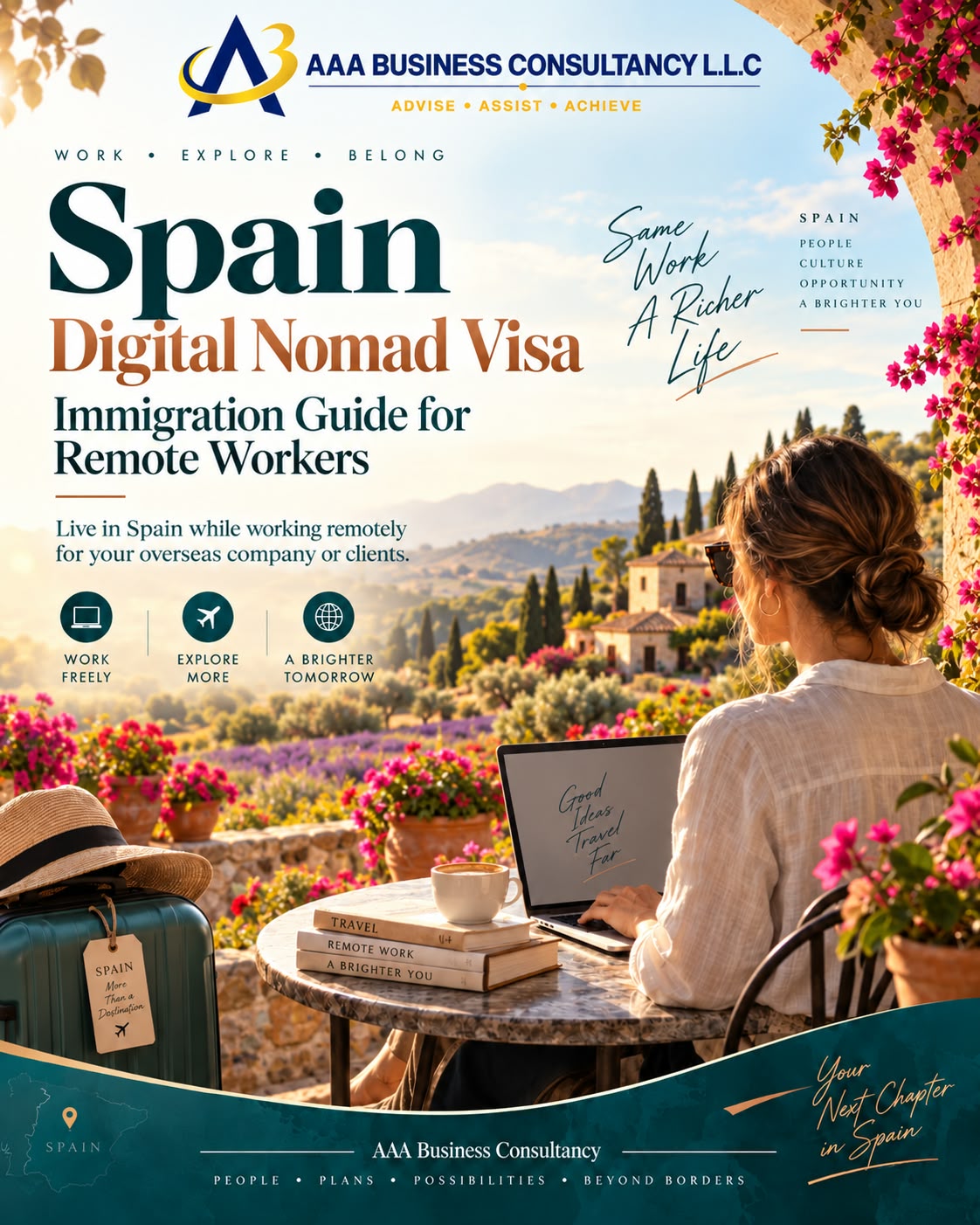
1. Digital Nomad Visa
Spain’s Digital Nomad Visa can be an option for eligible remote workers and professionals who meet the applicable requirements.
For families, the main applicant’s eligibility is only the first consideration. The eligibility and documentation requirements for accompanying family members should also be reviewed.
This route may be particularly relevant to professionals working remotely from the UAE or another country who want to relocate to Spain while continuing eligible remote professional activities.
2. Non-Lucrative Residence
The Non-Lucrative Residence route may be suitable for individuals who wish to live in Spain without carrying out work activities in Spain and who can demonstrate sufficient financial means.
For families, financial planning becomes especially important because the applicant must demonstrate adequate resources for the family members included or accompanying them.
The applicable financial requirements can depend on the number of family members and the current regulations.
3. Self-Employed or Business Residency
Entrepreneurs and self-employed professionals may have Spanish residency options depending on their professional background, qualifications, proposed business activity, business plan and financial circumstances.
If the applicant has a spouse or children, their immigration arrangements should be considered at the beginning of the process.
A family-focused immigration strategy can help avoid complications later.
4. Study Residence
Spain is also an attractive destination for international students.
Depending on the type and duration of the studies, eligible family members may have options to accompany the student or join them under the applicable regulations.
However, family members do not automatically receive the same residence status as the student. Specific requirements and procedures may apply.
Families considering Spain for education should therefore consider both the student’s residence and the arrangements available to accompanying family members.
5. Family Reunification
Family Reunification is an important part of Spain’s immigration system.
Certain foreign residents legally living in Spain may be able to apply for residence for eligible family members, subject to the applicable requirements.
Depending on the circumstances, this can include a spouse or qualifying partner, children and certain dependent parents or relatives.
Requirements may include evidence of the family relationship, financial means, suitable accommodation and health insurance.
Importantly, Family Reunification should not be confused with the family arrangements available under other Spanish residency categories.
Which Family Members Can Move to Spain?
The family members who can accompany or join the main applicant depend on the specific immigration pathway.
Spouse or Partner
A legally recognized spouse or qualifying partner may be eligible to accompany or join the main applicant, depending on the residence category.
The relationship must generally be supported by appropriate documentation.
Marriage or partnership documents issued outside Spain may require apostille or legalization and Spanish sworn translation, depending on the document and applicable requirements.
Children
Eligible children may also be able to accompany or join the main applicant.
The requirements can vary depending on the child’s age, relationship to the applicant and the selected residence category.
Birth certificates and other family documents should therefore be prepared carefully before the application.
Parents
Parents may be subject to additional requirements, particularly when applying through Family Reunification.
Dependency, age and other circumstances can be relevant depending on the applicable immigration route.
Families planning to relocate with parents should therefore have their circumstances reviewed before selecting a pathway.
Spain Residency Requirements for Families
There is no universal checklist that applies to every family because the requirements depend on the selected residency route.
However, families may need to prepare documents such as:
- Valid passports
- Marriage or partnership certificates
- Birth certificates
- Proof of family relationship
- Financial documentation
- Health insurance
- Accommodation documentation
- Criminal record certificates where applicable
- Educational documents where relevant
- Other supporting evidence required for the selected residency category
Foreign public documents may need apostille or legalization and Spanish sworn translation.
Preparing documents correctly is one of the most important parts of the Spain immigration process.
Can the Whole Family Apply Together?
Sometimes, yes.
Certain Spanish residency pathways allow eligible family members to accompany the main applicant or apply in connection with the principal application.
In other circumstances, family members may need to follow a separate procedure or join the main applicant after residence has been granted.
The correct approach depends on the residence category and the circumstances of each family member.
For this reason, families should determine the correct application structure before submitting their documents.
Moving to Spain With Children
For families with children, residency is only one part of the relocation decision.
Parents also need to consider education, healthcare, accommodation, transportation and the location where they intend to live.
Spain has public, private and international schools, offering different options depending on the child’s age, location and language preferences.
Families should begin researching education options early, particularly when planning a move around the Spanish academic calendar.
Healthcare When Moving to Spain
Healthcare is another important consideration for families planning their relocation.
Depending on the residency pathway, applicants and family members may need to demonstrate appropriate health insurance.
After obtaining residence, families may also need to complete additional procedures to access the healthcare arrangements applicable to their circumstances.
Understanding healthcare requirements before applying can help families prepare more effectively.
What Happens After You Arrive in Spain?
Getting your residency approval is not necessarily the end of the process.
Once the family arrives in Spain, additional administrative procedures may be required depending on the circumstances.
These can include:
NIE and TIE procedures, Empadronamiento, Digital Certificate, local registration, tax registration, Social Security procedures, healthcare arrangements and opening a Spanish bank account.
For families relocating from the UAE or another GCC country, preparing for these steps in advance can make the transition much more organized.
Common Spain Immigration Mistakes Families Should Avoid
One of the biggest mistakes families make is focusing only on the main applicant.
Before choosing a residency route, families should consider whether the spouse or partner can accompany the applicant, whether the children can be included, what financial evidence will be required, which documents need legalization or apostille, which documents require sworn translation and whether family members should apply together or separately.
Another common mistake is assuming that all Spanish residency categories have the same family rules.
They do not.
The requirements can differ significantly between residency pathways.
How to Choose the Right Spain Immigration Pathway
The best residency option depends on the family’s circumstances.
For example, a remote-working professional may have different options from a financially independent applicant, entrepreneur or international student.
Before making a decision, families should consider:
Your professional situation, financial resources, family structure, purpose of moving to Spain, documentation, long-term plans and the eligibility requirements of each pathway.
A professional assessment can help bring these factors together before the application begins.
Why Start With a Professional Case Assessment?
Every family is different, and a residency pathway that works well for one applicant may not be appropriate for another.
At AAA Business Consultancy, the process can begin with a Professional Eligibility Assessment (PCA).
The PCA provides an opportunity to review your profile, documents, financial circumstances, potential risks and available Spain residency options.
It also provides a personalized document checklist, professional recommendations and a step-by-step action plan.
This allows applicants to understand their position before moving forward with full processing.
Planning Your Spain Immigration Journey in 2026
Moving to Spain as a family can be the beginning of an exciting new chapter.
Whether your goal is to work remotely, establish a business, study, live in Spain with sufficient financial means or join a family member already residing there, choosing the appropriate immigration pathway is an important first step.
The process should not be viewed simply as “getting a visa.”
It is about creating a structured plan that considers the main applicant, eligible family members, finances, documentation, application requirements and life after arrival.
For families considering Spain in 2026, early preparation can provide greater clarity and help you approach your residency journey with confidence.
Frequently Asked Questions About Spain Immigration for Families
Can my spouse move to Spain with me?
In many circumstances, eligible spouses or qualifying partners may be able to accompany or join the main applicant. The exact process depends on the selected residency pathway.
Can my children move to Spain with me?
Eligible children may be able to accompany or join the main applicant, subject to the requirements of the applicable residence category.
Can I bring my parents to Spain?
In certain circumstances, dependent parents may qualify through applicable family reunification procedures. Additional requirements may apply.
How much money does a family need to move to Spain?
The financial requirements depend on the selected residency pathway and the number of family members. Families should assess the applicable requirements for their specific situation rather than relying on a single general figure.
Do family documents need to be translated?
Foreign documents may require Spanish sworn translation and, where applicable, apostille or legalization.
Can the whole family apply together?
In some cases, yes. In other situations, family members may need to follow a separate procedure or join the main applicant later.
What is the best Spain residency option for a family?
There is no single best option for every family. The appropriate route depends on the family’s professional situation, finances, purpose of relocation, family structure and eligibility.
Start Your Spain Immigration Journey With AAA Business Consultancy
Planning to move to Spain with your family?
Understanding your options before beginning the application can help you make a more informed decision and prepare the required documentation correctly.
At AAA Business Consultancy, we provide professional support for individuals and families planning their move to Spain, including Professional Eligibility Assessment, residency application preparation, document review, sworn translation coordination and administrative assistance.
Our goal is to provide a structured and professional approach to your Spain residency journey, helping you understand the available options and the steps involved.
Ready to explore your Spain residency options?
📧 Client Enquiries: client@aaabusinessconsultancy.com
🌐 Website: www.aaabusinessconsultancy.com
AAA Business Consultancy LLC
Advise • Assist • Achieve
Spain Visa & Residency Services