People applying for a Spain visa or residence permit often focus on the application form, bank statements, and appointment—but one of the most confusing parts of the process is document authentication.
Applicants frequently ask:
Does my document need an Apostille? Does it need legalisation? Should it be translated before or after authentication?
The answer depends on the type of document, the country where it was issued, and the Spanish authority handling the application.
At AAA Business Consultancy L.L.C., we assist clients with Spain visa and residency documentation, including document review, sworn translation coordination, and guidance on authentication requirements.
What Is an Apostille?
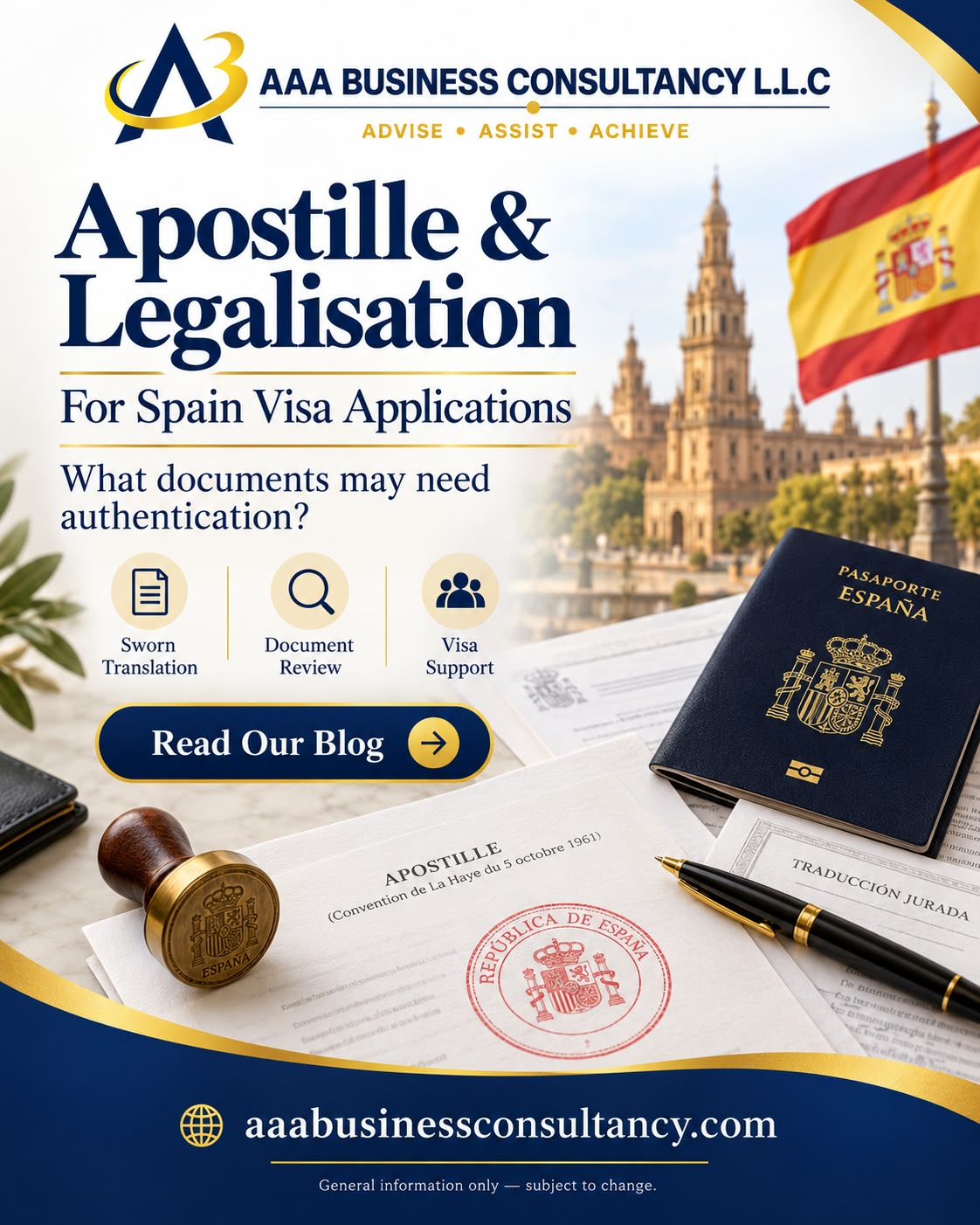
An Apostille is a form of authentication used for certain public documents issued in countries participating in the Hague Apostille Convention.
It confirms the authenticity of elements such as the signature, seal, or authority appearing on the document.
An Apostille does not confirm that the information written inside the document is correct. Its purpose is to authenticate the official origin of the document.
What Is Document Legalisation?
When an Apostille procedure does not apply, a document may instead require a legalisation process.
Depending on the issuing country, this can involve authentication by government authorities and, in some cases, diplomatic or consular procedures.
The correct route depends primarily on where the document was issued, not simply on the applicant’s nationality.
Which Documents May Require Authentication for Spain?
Depending on the Spain visa or residence application, applicants may be asked to submit authenticated public documents such as:
Police Clearance Certificates
Birth Certificates
Marriage Certificates
Academic Certificates
University Degrees
Civil Status Documents
Family Relationship Documents
Certain official employment or professional certificates
Other government-issued documents
Not every document requires an Apostille or legalisation.
The requirement should always be checked according to the specific procedure.
Police Clearance Certificates
Police clearance documents are commonly required for several long-stay Spain immigration procedures.
Depending on the applicant’s history and visa category, authorities may require certificates from countries where the applicant has lived during a specified period.
Applicants should carefully check:
Which countries must issue the certificate
How recently it must have been issued
Whether authentication is required
Whether a Spanish translation is required
Obtaining the correct police certificate but failing to authenticate it properly can create unnecessary delays.
Birth and Marriage Certificates
Family applications can involve birth certificates, marriage certificates, and other documents proving family relationships.
These documents may be especially important when:
A spouse is applying as a dependant
Children are included in an application
Family reunification is requested
A parent-child relationship must be demonstrated
Authorities may require both authentication and Spanish translation depending on the circumstances.
University Degrees and Academic Documents
Academic documents can be important in applications such as the Spain Digital Nomad Visa, Study Visa, Highly Qualified Professional routes, and some professional or employment-based applications.
Applicants may need to provide evidence of:
University qualifications
Professional qualifications
Academic records
Relevant experience
Whether an academic document requires authentication will depend on the specific procedure and issuing country.
Should You Translate the Document Before or After Apostille?
This is an important question.
In many cases, applicants should first confirm the authentication requirements and then arrange the required Spanish translation so that all relevant information—including the Apostille or legalisation details where necessary—is properly covered.
However, procedures can vary.
Applicants should avoid arranging translations too early without confirming whether the document first requires authentication.
Otherwise, additional translation work may later be necessary.
What Is a Sworn Translation?
Certain Spain immigration and administrative procedures may require foreign-language documents to be translated into Spanish.
Depending on the authority and procedure, an official sworn translation (Traducción Jurada) may be required.
AAA Business Consultancy assists with sworn translation coordination for documents including:
English to Spanish
Arabic to Spanish
Urdu to Spanish
Civil documents
Police certificates
Academic documents
Employment documents
Business documents
Financial and supporting documents
Apostille vs Sworn Translation
These are two completely different procedures.
Apostille or legalisation verifies the official origin of a document.
Sworn translation converts the contents of the document into Spanish in an officially recognised format where required.
Some documents may require:
Original Document → Authentication/Apostille → Spanish Sworn Translation
But the exact order and requirement should always be confirmed for the particular case.
Does Every Spain Visa Require Apostilled Documents?
No.
A Spain Tourist or Business Schengen Visa application is different from a long-term residency application.
Long-stay or residence procedures may involve more public documents that require formal authentication.
This can include applications such as:
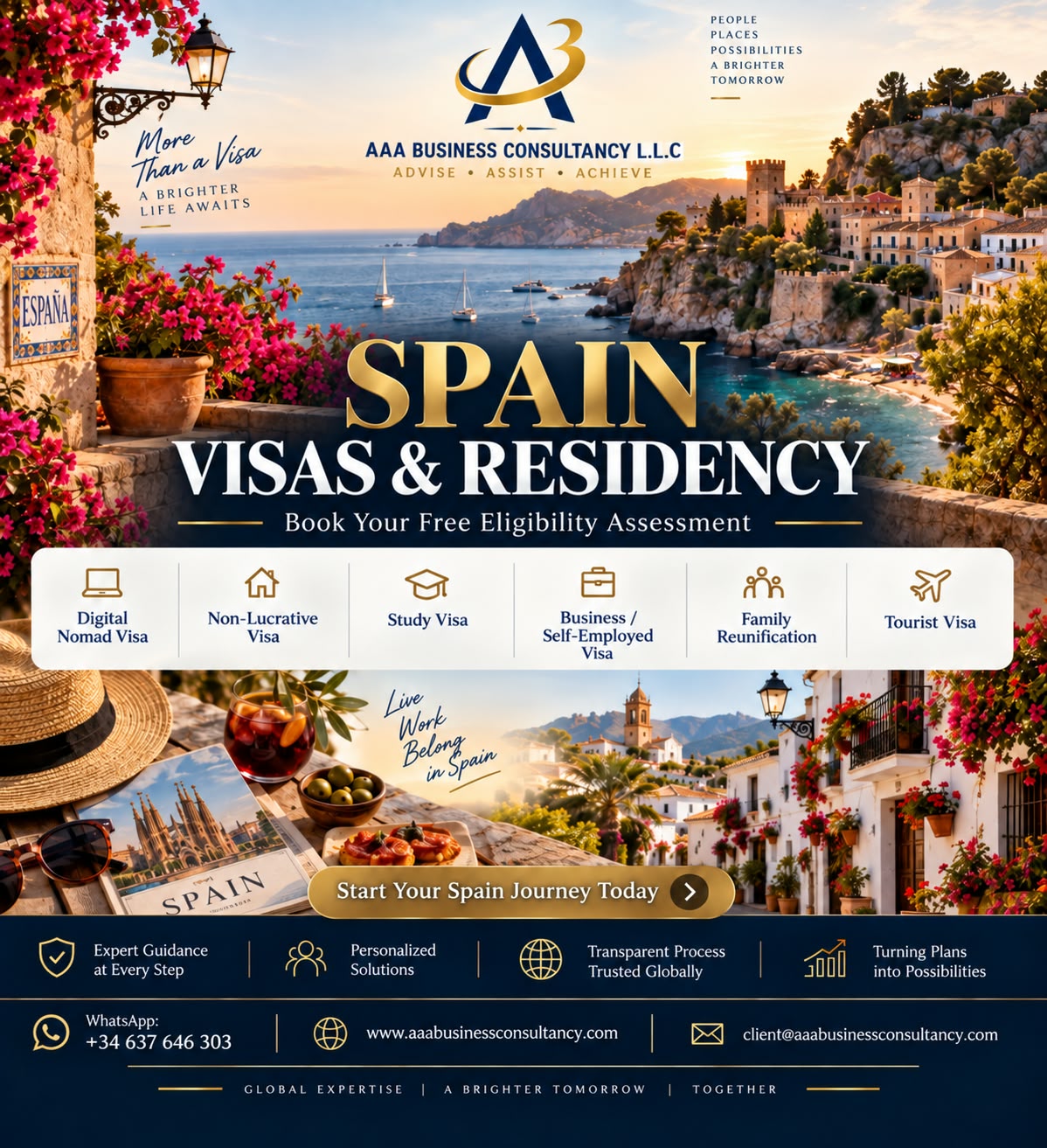
Digital Nomad Visa
Non-Lucrative Visa
Study Visa
Self-Employed Residence
Family Reunification
Employment Residence
Other long-term Spain immigration procedures
The required documents vary significantly between visa categories.
Common Authentication Mistakes
Applicants should avoid:
Apostilling a document that does not require it
Failing to authenticate a document that does require it
Using an expired or outdated certificate
Translating a document before completing required authentication
Forgetting to translate the Apostille or authentication page where required
Assuming UAE-issued and foreign-issued documents follow the same procedure
Following another applicant’s checklist without checking their own case
Submitting incomplete copies
Using unofficial translations where a sworn translation is required
Documents Issued Outside the UAE
UAE residents often submit documents issued in several different countries.
For example, an applicant living in Dubai may have:
A passport from one country
A university degree from another country
A marriage certificate from another jurisdiction
A police certificate from the UAE
Each document may therefore follow a different authentication procedure.
This is why document preparation should be reviewed document by document.
How AAA Business Consultancy Can Assist
AAA Business Consultancy L.L.C. assists clients preparing Spain visa and residency applications with services including:
Spain visa eligibility assessment
Professional Case Assessment
Personalised document checklist
Complete document review
Apostille and legalisation guidance
Sworn translation coordination
Financial document review
Digital Nomad Visa support
Non-Lucrative Visa support
Study Visa support
Self-Employed and Business Residency
Family Residency
Spain relocation and administrative assistance
Our objective is to identify document requirements early so applicants can prepare their files in the correct sequence.
Prepare Your Documents Before Your Spain Visa Application
Authentication and translation mistakes can cost applicants valuable time.
Before arranging an Apostille, legalisation, or sworn translation, determine:
What document is required
Where it was issued
Whether authentication is necessary
Whether Spanish translation is required
Whether the document has a validity period
Which Spanish authority will receive it
A properly planned document process can make the overall Spain visa application much more organized.
AAA Business Consultancy L.L.C.
Advise • Assist • Achieve
Important Disclaimer
The information provided in this article is for general informational purposes only and does not constitute legal or immigration advice.
Spain visa, immigration, Apostille, legalisation, translation, documentation, consular, and administrative requirements are subject to change and may vary depending on the visa category, issuing country, applicant’s circumstances, and competent Spanish authority.
Applicants should always verify the latest official requirements applicable to their individual case before proceeding.